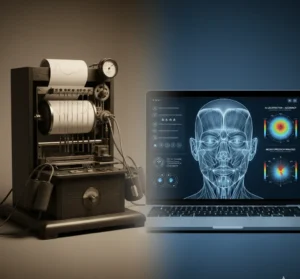
A polygraph test has long been a familiar tool in criminal investigations, corporate screenings and even family disputes. Yet once a case reaches the courtroom, a natural question arises: is a polygraph result admissible as evidence in court, and how much legal weight does it carry in the Ukrainian legal system? In this article we take a detailed look at the legislative framework, case law, expert-examination requirements and real precedents, so you know exactly what to expect from a polygraph in court.

The legal framework for polygraph use in Ukraine
To understand the legal status of the polygraph as evidence in court, you need to look at several key statutes that regulate this area directly or indirectly.
The Criminal Procedure Code of Ukraine (CPC)
The Ukrainian CPC contains no direct ban on the use of a polygraph. Article 84 establishes that evidence is any factual data on the basis of which a court determines the presence or absence of circumstances in a case. Article 242 provides for the appointment of a forensic examination in cases where special knowledge is required to clarify the circumstances. It is precisely through the institution of forensic examination that the results of a polygraph examination most often enter the case file of criminal proceedings.
At the same time, Article 87 of the CPC lays down the rules on the inadmissibility of evidence obtained in breach of proper procedure. This means that the procedure for conducting a polygraph test must be flawless: voluntary consent, a qualified specialist, and a documented process.
The Law of Ukraine "On Operative and Investigative Activities"
Article 8 of this law grants operative units the right to use technical means, including the polygraph, in the course of operative and investigative measures. This officially recognizes the polygraph as an auxiliary tool of law-enforcement work. However, the materials of operative and investigative activity only become evidence once they have been formalized procedurally in accordance with the CPC.
The Law "On Forensic Examination"
This law sets out the general principles for conducting forensic examinations in Ukraine. A polygraph examination can be formalized as an expert opinion provided that the specialist holds the appropriate qualifications and certificate and works within an approved methodology. It is compliance with these requirements that determines whether the court will accept the opinion as admissible evidence.
Key fact: There is no separate "Polygraph Act" in Ukraine. The legal status of the test is governed by a set of statutes — the CPC, the Law on Operative and Investigative Activities, the Law on Forensic Examination, and secondary regulations of the Ministry of Justice.
When courts accept polygraph results
Case law in Ukraine shows that a polygraph examiner's opinion can be accepted by a court when a number of conditions are met. Let's look at the key criteria for admissibility.
Formalization as an expert opinion
A polygraph examination stands the best chance of recognition when it is formalized as a forensic expert opinion. To achieve this, the specialist must:
- hold a qualification certificate issued by the Ministry of Justice of Ukraine;
- be listed in the Register of Forensic Experts;
- work within the approved methodology for conducting polygraph examinations;
- draft the opinion in accordance with the requirements of the Instruction on the Appointment and Conduct of Forensic Examinations.
Voluntary written consent
A mandatory condition of admissibility is that the test be taken voluntarily. The person must be informed about the nature of the procedure, their rights, and their ability to withdraw at any moment. Coercing someone into taking a polygraph is a gross violation that automatically renders the results inadmissible.
Proper documentation of the procedure
The entire testing process must be documented: a video recording of the session, a record of the interview, the list of questions, the reaction charts, and a statement confirming that the subject was informed of their rights. The absence of any of these elements can become grounds for challenge.
Examination ordered by a court or investigator
In criminal proceedings, an examination using a polygraph may be ordered by an investigating judge at the request of the prosecution or the defense. In civil cases, it is ordered by a court ruling at the request of one of the parties. An appointment by an authorized body substantially increases the procedural weight of the results.
Tip: If you plan to use test results in court proceedings, take care of proper documentation in advance. TestStimul specialists will help you organize the procedure with all legal requirements in mind.
When courts reject polygraph results
There are plenty of cases where courts refuse to accept the results of a polygraph examination. The main reasons for rejection are as follows.
Lack of qualification of the specialist
If a polygraph examiner does not hold a forensic expert certificate or is not listed in the relevant register, their opinion is treated merely as a consultative document rather than full-fledged evidence. Courts have repeatedly noted that opinions of "private polygraph examiners" without proper qualifications cannot form the basis of a decision.
Breach of procedure
Typical violations that lead to results being ruled inadmissible:
- absence of written consent from the person being tested;
- conducting the test under pressure (from an employer, investigator, or partner);
- an incorrect methodology — invalid questions, breach of protocol;
- lack of video recording of the process;
- testing a person under the influence of alcohol or medication;
- examining minors without observing additional safeguards.
Use as the sole piece of evidence
Ukrainian courts consistently hold that a polygraph cannot be the sole piece of evidence on which a decision is based. A polygraph examiner's opinion is assessed together with the other evidence in the case — witness testimony, physical evidence, documents, and the findings of other examinations.
Important: Even a flawlessly conducted polygraph test does not guarantee that the court will base its verdict on the results. The polygraph is an additional tool within the system of proof, not a replacement for it.
Court precedents in Ukraine: the real practice
An analysis of Ukrainian court decisions in recent years shows a mixed, but on the whole positive, attitude toward the polygraph in the judicial process.
Criminal proceedings
In criminal cases, courts most often accept a polygraph examiner's opinion as supporting evidence that confirms or refutes the testimony of a suspect or witness. For example, appellate courts have repeatedly upheld verdicts in which a polygraph examiner's opinion was one element of the evidence base alongside physical evidence and testimony.
At the same time, the Supreme Court has noted in a number of rulings that polygraph results cannot replace a full investigation and must be assessed critically, taking all the circumstances of the case into account.
Civil and family cases
In civil proceedings the polygraph is used less often, but with a rising trend. Typical situations include:
- Family disputes — determining a child's place of residence, establishing the fact of domestic violence.
- Labor disputes — cases of dismissal for loss of trust, theft, or NDA breaches.
- Inheritance cases — contesting wills, proving that pressure was placed on the testator.
- Corporate conflicts — confirming or refuting instances of fraud.
In civil cases, courts treat polygraph results with greater caution, but accept them as circumstantial evidence if they have been properly formalized.
Labor disputes and corporate investigations
A separate category is the use of the polygraph in employment relations. Employers often initiate testing of staff when they suspect theft, information leaks, or breaches of corporate rules. If the matter reaches court:
- Polygraph results are acceptable only if the employee gave voluntary consent.
- Refusal to take the test cannot be grounds for dismissal.
- A polygraph examiner's opinion is only one element of the employer's evidence base.
For corporate screenings and to ensure personnel security, it is important to follow all procedural requirements from the very start.
Requirements for a polygraph expert
The specialist's qualifications are one of the decisive factors in the admissibility of the results. A forensic polygraph expert in Ukraine must meet the following criteria:
- Education: a higher degree in law or psychology.
- Specialized training: completion of a polygraph course approved by the Ministry of Justice.
- Certification: a qualification certificate as a forensic expert in the specialty "Polygraph Examinations."
- Registration: inclusion in the Unified Register of Forensic Experts of Ukraine.
- Experience: a record of practical work and regular professional development.
Note: Before a test, always verify the specialist's qualifications. A certificate from a private training center without recognition by the Ministry of Justice is not enough for the results to be used procedurally.
Polygraph in criminal vs civil cases: the key differences
The legal weight and the procedure for using a polygraph differ significantly depending on the type of proceeding.
Criminal proceedings
- The examination is ordered through an investigating judge or prosecutor.
- Stricter requirements for procedure and documentation.
- The standard of proof is "beyond reasonable doubt."
- Results are assessed under the principle of the court's free evaluation of evidence.
- A suspect has the right to refuse the test without any consequences.
Civil proceedings
- Ordered at a party's request, by court ruling.
- A less formalized procedure.
- The standard of proof is the "balance of probabilities."
- Parties may submit opinions from private experts.
- Refusal to take the test may be assessed by the court as an indirect sign.
Administrative cases
In administrative proceedings the polygraph is used least of all. However, in cases connected with public service, integrity checks of officials, or appeals against appraisal results, a polygraph examiner's opinion may be taken into account as supplementary material. For government departments, the question of properly formalizing the test is especially relevant.
International experience: how other countries treat the polygraph in court
To fully understand the situation in Ukraine, it is useful to compare how different countries approach the legal validity of the polygraph.
The United States
In the United States there is no single approach — the matter is regulated at the state level. In most states, polygraph results are inadmissible evidence because of the Supreme Court's decision in Daubert v. Merrell Dow Pharmaceuticals (1993), which set strict requirements for the scientific validity of expert opinions. At the same time, in some states (New Mexico, for example) results are accepted with the consent of both parties. The federal EPPA (Employee Polygraph Protection Act) prohibits most employers from requiring a polygraph as a condition of employment.
European Union countries
Most EU countries do not recognize polygraph results as court evidence. Germany, France and the Netherlands hold that a polygraph examination lacks sufficient scientific validity for use in the judicial process. However, in Poland and some Baltic states the polygraph is used in operative and investigative work and in vetting the personnel of special services.
Israel
Israel is one of the leaders in the use of the polygraph. Test results are widely applied by law-enforcement agencies and special services. In case law, the polygraph is admitted as auxiliary evidence under certain conditions.
Japan and South Korea
In these Asian countries the polygraph enjoys considerably wider recognition. In Japan, the results of polygraph examinations are regularly used as evidence in criminal cases and are considered an important element of the investigation.
Comparison: Ukraine occupies an intermediate position — the polygraph is not banned, but it does not have unconditional recognition either. The approach is closest to the Israeli model: admissibility on condition that the procedure is followed and a qualified specialist is involved.
How to prepare test results for court
If you plan to use the results of a polygraph examination in court proceedings, you need to prepare carefully. Below is a step-by-step algorithm.
Step 1: Choose a qualified specialist
Check for a forensic expert certificate, an entry in the Register, and experience with court cases. Ideally, turn to a specialist who has a track record of testifying in court as an expert.
Step 2: Obtain voluntary consent
The subject signs an informed consent form that sets out the purpose of the test, its voluntary nature, the right to refuse, and how the results will be used.
Step 3: Ensure proper documentation
- A video recording of the entire procedure.
- A record of the pre-test interview and the main testing.
- A full list of questions with justification for their relevance to the subject of the examination.
- Polygrams (reaction charts) with the expert's commentary.
- A final opinion answering the questions posed.
Step 4: Add the opinion to the case file
In criminal proceedings — through a motion to order an examination or to attach the specialist's opinion. In a civil case — as written evidence or an expert opinion through the appropriate motion.
Step 5: Prepare for questioning of the expert
The court or the opposing party may request a questioning of the polygraph examiner to clarify the details of how the test was conducted. An experienced expert must be ready to give a reasoned response to critical questions about the methodology, equipment, and interpretation of the results.
Tip: Learn how StimulTest works — this modern platform lets you obtain documented test results suitable for further use for legal purposes.
Limitations of the polygraph: what you need to know
An objective analysis of the legal validity of the polygraph is impossible without understanding the limitations of the method.
Physiological factors
Test results can be distorted due to:
- chronic diseases of the cardiovascular or nervous system;
- taking medication that affects the autonomic nervous system;
- pregnancy;
- extreme fatigue or a state of stress.
Psychological factors
- A high level of anxiety can produce a false-positive result.
- Sociopathic disorders — reduced physiological reactivity to lying.
- Attempts at countermeasures — deliberately distorting the reactions.
Methodological limitations
The polygraph measures physiological reactions, not the fact of lying itself. A stress reaction can be triggered by various causes — fear of a false accusation, anxiety, or a traumatic memory. That is why the interpretation of results always contains an element of subjectivity that depends on the examiner's qualifications and experience.
Important: No method — neither the classic polygraph nor modern behavior-analysis systems — offers 100% accuracy. That is precisely why courts consider test results only in combination with other evidence.
Modern alternatives: online verification technologies
Besides the classic polygraph with sensors, there are now remote methods of assessing truthfulness based on the computer analysis of micro-expressions, voice and behavior. Such technologies offer a number of advantages for legal purposes:
- Automated processing — reduces the subjectivity of interpretation.
- Full video capture — documentation of the process happens automatically.
- Remote format — the ability to run a test for private individuals regardless of their location.
- Reduced stress — the absence of sensors and of an unfamiliar office lowers the number of false-positive results.
- Digital report — a structured document with charts and analytics.
The TestStimul platform combines the advantages of modern technology with the ability to obtain documented results. You can read more about the online polygraph and how it works on the "How StimulTest works" page.
The role of StimulTest in legal processes
Although the results of any test require proper procedural formalization to be used in court, StimulTest can be a helpful tool at various stages of the legal process:
- Pre-trial preparation: assessing the credibility of testimony before shaping a legal position.
- Corporate investigations: a documented check for businesses running internal investigations.
- Mediation: an independent check to help reach a settlement.
- Personnel security: vetting candidates for government agencies and safeguarding enterprises.
- Personal matters: a check for private individuals in family conflicts and inheritance disputes.
The outlook for legislative regulation
The question of a separate polygraph law in Ukraine has been under discussion for more than a decade. Among the key directions of the expected changes are:
- The adoption of a dedicated law that would define the status of the polygraph, the requirements for specialists, and the procedure for using the results.
- Expanding the list of areas where use is mandatory — in particular, for admission to public service, in law-enforcement agencies, and in special services.
- Recognizing the results of modern digital truthfulness-verification methods on a par with the classic polygraph.
- Harmonization with European standards in the context of Ukraine's European integration.
Until a separate law is adopted, legal practice is shaped mainly through court precedents and the secondary regulations of the relevant agencies.
Practical recommendations: what to consider before a test
To sum up our analysis of the legal validity of the polygraph in Ukraine, here are some practical recommendations for those who plan to use test results for legal purposes.
For private individuals
- Always ask for confirmation of the polygraph examiner's qualifications.
- Do not agree to a test under pressure — that is a violation of your rights.
- Insist on a video recording of the entire procedure.
- Consult a lawyer about whether a test makes sense in your particular situation.
For businesses and employers
- Include a provision on voluntary testing in the company's internal regulations.
- Do not use a refusal to take the polygraph as the sole grounds for disciplinary action.
- Keep full documentation of every test conducted.
- Engage only certified specialists or trusted platforms such as TestStimul for business.
For attorneys and lawyers
- Assess whether a polygraph examiner's opinion will strengthen your position or risks weakening it.
- Arrange for the examination to be ordered through the court rather than "privately" — this substantially increases its procedural weight.
- Prepare your client for possible questioning of the expert by the opposing party.
- Use the polygraph examiner's opinion as part of a comprehensive evidence strategy.
Conclusion: polygraph and court — what really works
So, a polygraph in court in Ukraine is neither absolute proof nor a useless formality — it is a tool with real legal weight when applied correctly. The results of a polygraph examination can be accepted by a court as admissible evidence if all procedural requirements are met: the expert's qualifications, voluntariness, proper documentation, and correct formalization of the opinion.
Case law is gradually moving toward wider recognition of the polygraph, especially in criminal cases. At the same time, it is important to understand the limitations of the method and to use it as part of a comprehensive evidence strategy, not as the only argument.
Preparing evidence for a court case or an internal investigation? Certified examiner, full confidentiality, online and in person. Leave a request — we reply within 15 minutes.
Latest articles