
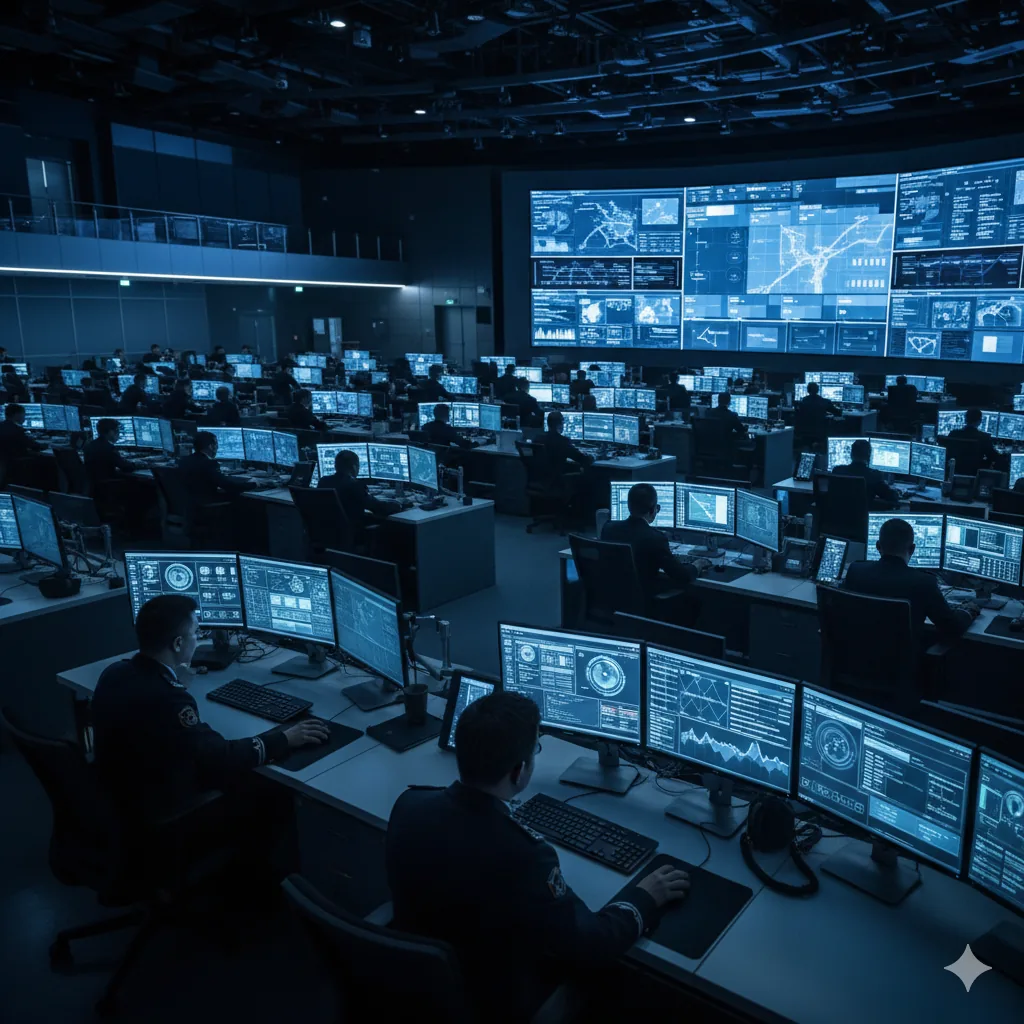
Government agencies operate under constant threats: corruption, leakage of classified information, infiltration by hostile agents, terrorism, and smuggling. Each of these threats starts with the human factor — with a specific individual acting contrary to the interests of the state. Conventional personnel vetting methods — interviews, questionnaires, and even the polygraph — have significant limitations: they are slow, expensive, and easily manipulated by a prepared subject. When hundreds or thousands of individuals need to be screened within a short timeframe, traditional approaches become impractical.
StimulTest is a fundamentally different verification technology, developed for large-scale screening with the highest level of information protection. The system measures reaction speed to masked stimuli and reveals concealed information at the level of subconscious reflexes that cannot be controlled by willpower. For the government sector, this means the ability to regularly screen an entire unit's personnel without engaging a large number of specialists and without the risk of data compromise.
How StimulTest Works
StimulTest technology is based on measuring reaction speed to masked stimuli. During testing, carefully masked stimuli — phrases or images — appear on the computer screen. The subject presses the same key whenever a stimulus appears. The procedure takes only 20–30 minutes, yet during this time the system collects thousands of micro-measurements of reaction time.
The fundamental feature of the method is that the subject does not know what is actually being tested. The stimuli are masked so thoroughly that a person sees only the surface layer of information. At the same time, the subconscious reacts to meaningful stimuli by changing reaction speed — under stress, reflexes automatically accelerate or slow down. This is an involuntary reaction that cannot be suppressed by willpower, which makes the technology fundamentally resistant to deception attempts.
Before the main test, individual calibration is performed to account for each person's personal reaction characteristics. The results are processed using artificial intelligence and Big Data technologies. A detailed description of how the technology works is available on the "How StimulTest Works" page.
The ability to conduct remote testing without physical sensors makes StimulTest especially valuable for government structures with geographically distributed units — from border checkpoints to remote correctional facilities.
Areas of Application in the Government Sector
StimulTest adapts to the specific tasks of various government agencies. Below are the key areas where the technology addresses critical national security challenges.
Law Enforcement
Law enforcement agencies — police, security services, investigative units — face a twofold challenge. On one hand, they need to verify information obtained from suspects, witnesses, and informants. On the other, they must ensure the internal security of their own units by excluding the presence of corrupt or disloyal employees.
StimulTest enables regular scheduled screening of personnel without significant time or budget expenditures. The system detects concealed involvement in criminal activity, connections to organized crime, and facts of abuse of office. At the same time, the subject cannot prepare for the test because they do not know which stimuli are diagnostic.
- Scheduled attestation of operational personnel
- Screening of candidates for service in law enforcement agencies
- Verification of testimony during internal investigations
- Clearance checks for access to classified information
- Identification of individuals linked to criminal groups
Anti-Corruption
Corruption poses one of the most serious threats to the functioning of the government apparatus. Its detection is complicated by the fact that corruption schemes typically involve collusion among several individuals, and participants are well aware of the consequences of exposure and carefully conceal their participation. The traditional polygraph has limited effectiveness in fighting corruption, as a well-prepared official is able to control physiological reactions.
StimulTest measures subconscious reactions that are not subject to conscious control. Even an experienced corrupt official who has trained to beat the polygraph will be unable to mask changes in reaction speed to stimuli related to corrupt activity — because they do not even understand what is actually being tested.
- Anti-corruption screening of civil servants at all levels
- Screening of members of tender committees and procurement procedures
- Verification of officials with access to the allocation of budget funds
- Regular monitoring of the loyalty of personnel in anti-corruption bodies
Counter-Terrorism and Anti-Smuggling
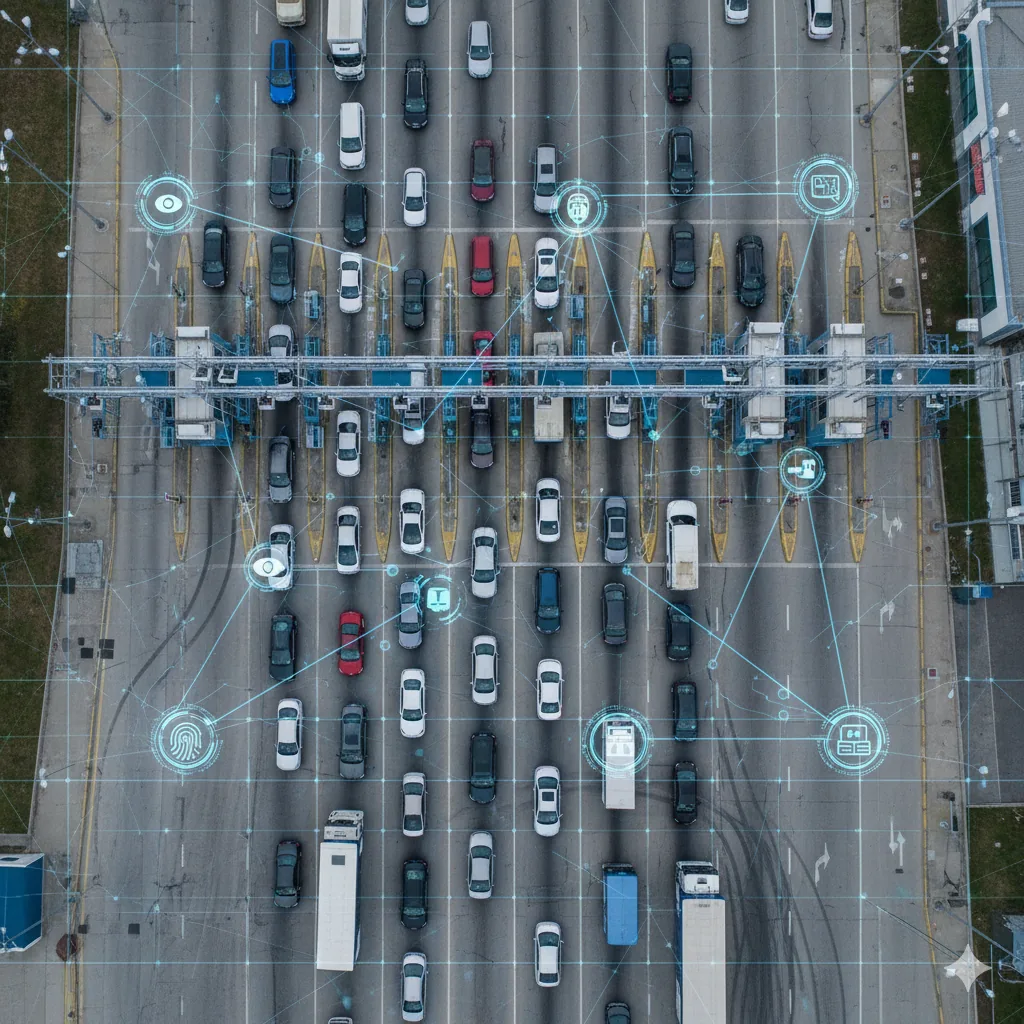
In the field of counter-terrorism, the cost of a mistake is extremely high. The need to identify potential threats among a large number of individuals — at checkpoints, in operational zones, at critical infrastructure facilities — requires a tool that combines speed and reliability.
StimulTest provides precisely this combination. Testing a single candidate takes 20–30 minutes and does not require complex equipment — only a computer with the installed software. This makes it possible to deploy testing points in field conditions, at checkpoints, and in security zones.
In the field of anti-smuggling, StimulTest identifies concealed ties to smuggling networks among customs officers, border service personnel, and logistics company employees. Regular screening makes it impossible for corrupt channels — through which weapons, narcotics, and other prohibited goods are smuggled — to operate for extended periods.
- Screening of individuals for involvement in terrorist organizations
- Vetting of personnel at critical infrastructure facilities
- Identification of smuggling channels through screening of customs and border service employees
- Monitoring of risks among individuals with access to explosives, weapons, and hazardous materials
Immigration Control
Immigration services process significant flows of individuals, among whom may be persons with a criminal past, ties to terrorist organizations, or the intent to commit offenses on state territory. Standard verification procedures — interviews, document checks, database queries — are not always able to uncover concealed information.
StimulTest complements existing immigration control procedures by providing a tool for mass screening. The technology reveals hidden biographical facts, true intentions, and connections to undesirable organizations. Because testing does not depend on a language barrier (stimuli can be adapted to different languages and cultural contexts), StimulTest works effectively with migrants from various regions.
- Screening of refugees and asylum seekers
- Vetting of visa applicants from high-risk areas
- Identification of individuals with falsified identities
- Checking immigration service personnel for loyalty and the absence of corruption ties
Correctional System
Correctional facilities are a high-risk environment in which two groups interact, both of which require regular screening: inmates and staff. Among inmates, it is necessary to identify those planning escape, organizing criminal activity from behind bars, or exerting pressure on other prisoners. Among staff — individuals involved in smuggling prohibited items, corruption schemes, and abuse of authority.
StimulTest makes it possible to conduct regular screening of both categories without involving external specialists. The system is deployed on autonomous servers directly at the correctional facility, which eliminates the risk of leaks of data regarding operational checks.
- Vetting of inmates prior to parole decisions
- Identification of channels for supplying prohibited items to the facility
- Regular attestation of correctional facility personnel
- Recidivism risk assessment
- Identification of individuals organizing criminal activity from places of detention
Personnel Security for Government Officials
Personnel security is the foundation of an effective government apparatus. Every government official with access to confidential information, budget funds, or strategic decision-making can potentially become a target of recruitment, blackmail, or corruption influence.
StimulTest provides a systematic approach to personnel security — from the stage of hiring into the civil service to regular scheduled checks of existing employees. The accuracy of the technology minimizes both false positives and false negatives, which is critically important for protecting the rights of honest public servants.
- Screening of candidates for positions with high security clearance
- Regular loyalty checks of current officials
- Identification of individuals under the influence of foreign intelligence services
- Verification when upgrading the level of access to classified information
- Monitoring of personnel following the detection of security incidents
Tasks and Capabilities of StimulTest
The table below summarizes typical tasks of government agencies and the corresponding capabilities of StimulTest technology.
| Area | Typical Tasks | StimulTest Capabilities |
|---|---|---|
| Law enforcement | Personnel attestation, candidate screening, internal investigations | Mass screening of units in 1–2 days, detection of hidden ties to the criminal world |
| Anti-corruption agencies | Identifying corruption risks, verifying declarations, monitoring officials | Detection of hidden assets and corruption ties, no possibility of preparing for the test |
| Counter-intelligence and counter-terrorism | Identification of enemy agents, screening for involvement in terrorist organizations | Testing in field conditions, rapid deployment, adaptation of stimuli to specific threats |
| Border and customs service | Identification of smuggling channels, checking personnel loyalty | Regular screening of checkpoint personnel, detection of ties to smuggling networks |
| Immigration service | Screening of migrants, vetting of applicants, risk identification | Mass processing of applicant flows, adaptation to different language and cultural contexts |
| Correctional system | Inmate risk assessment, staff screening, crime prevention | Autonomous deployment at correctional facilities, screening without external specialists |
| Ministerial personnel security | Access to classified information, screening upon appointment, regular monitoring | Integration into existing background check procedures, systematic loyalty monitoring |
Information Security
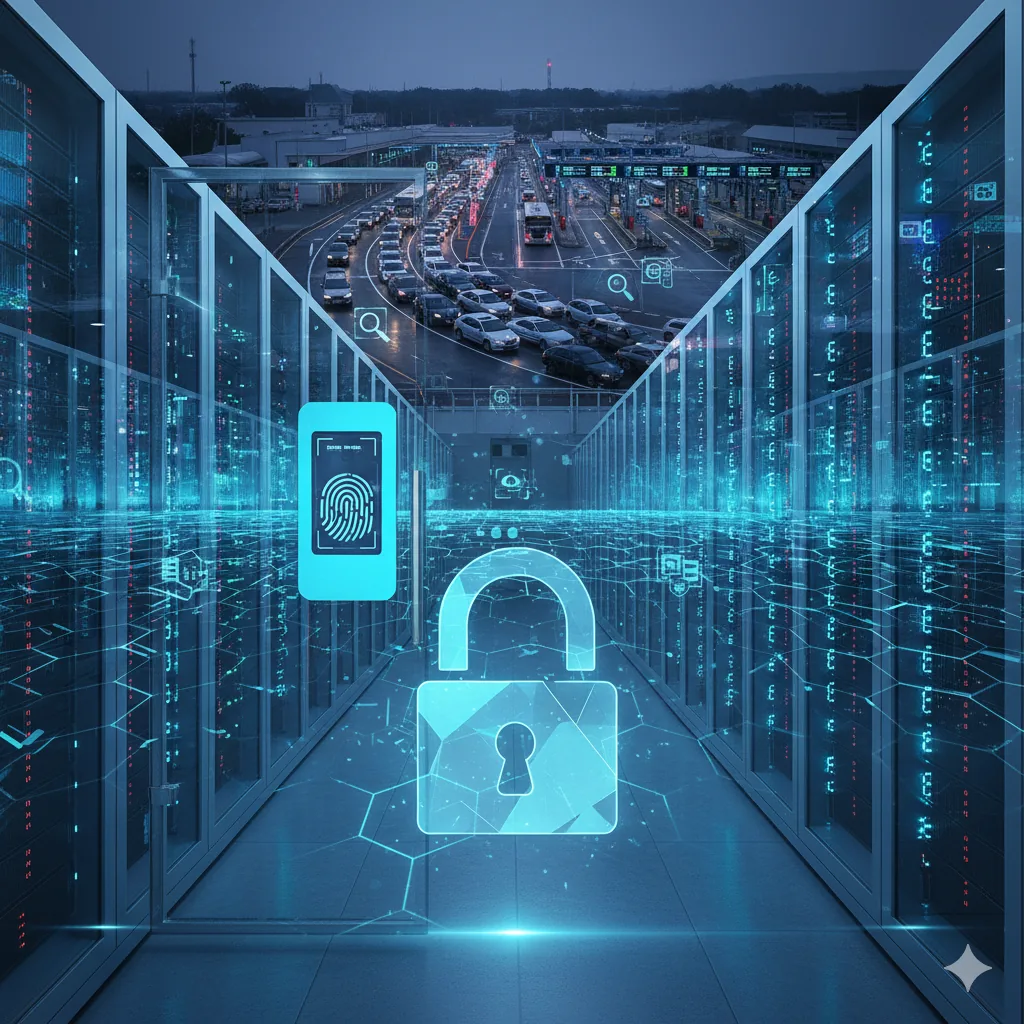
For government agencies, information protection is not a preference but a categorical requirement. Results of testing personnel of intelligence services, law enforcement, and military units contain information whose disclosure could pose a threat to national security. This is precisely why StimulTest's architecture has been designed with the highest information security standards in mind.
Autonomous Servers in the Client's Data Center
StimulTest is deployed on autonomous servers directly in the government agency's data center. This means that no data — neither source testing materials, nor results, nor personal information of subjects — is transmitted through external networks or stored on third-party servers. The government agency retains full sovereignty over all data.
Technical Security Measures
- Physical isolation: servers operate within the agency's secure perimeter without connection to external networks
- Data encryption: all data is stored and processed in encrypted form
- Role-based access: a multi-tier access control system with authentication and action logging
- Operations audit: complete logging of all data operations to ensure accountability
- Backups: automatic creation of encrypted backups in a controlled environment
Regulatory Compliance
The StimulTest architecture meets the requirements of current legislation in the field of information protection, including data protection laws, regulations on the protection of state secrets, and information security standards for government information systems. Deployment on the agency's own servers simplifies the procedure of obtaining the necessary approvals and passing the certification of the information protection system.
Benefits for Government Agencies
StimulTest creates qualitatively new capabilities for the government sector compared with traditional screening methods. Below are the key advantages that matter when making a decision on implementation.
Scalability
One of StimulTest's greatest advantages is its ability to perform mass screening. Whereas a classic polygraph allows for testing 2–3 individuals per day (including preparation, conducting, and analysis), StimulTest enables dozens of individuals to be tested daily at a single workstation. With several parallel stations in place, an entire unit of several hundred people can be screened within a week.
Speed and Efficiency
Testing a single candidate takes 20–30 minutes. Results are generated automatically using artificial intelligence, which eliminates the subjective factor in interpretation. There is no need to engage expensive external polygraph examiners — the system is operated by a trained operator after brief training.
Tamper-Proof
This is a key advantage for the government sector, where subjects often have both the motivation and resources to prepare for a test. StimulTest measures involuntary subconscious reactions that cannot be consciously controlled. The subject does not know which stimuli are diagnostic, cannot determine the moment of a critical measurement, and is unable to change the speed of a subconscious reaction through willpower. Polygraph counter-measures do not work against StimulTest because the technologies are fundamentally different.
Cost Efficiency
The cost of mass screening with StimulTest is substantially lower than conducting a comparable number of polygraph examinations. There is no need to maintain a staff of certified polygraph examiners or to purchase and service physical sensors. After the initial deployment of the system, the cost of each subsequent test is minimal.
Remote Testing
For agencies with a geographically distributed structure — border service, regional police units, remote correctional facilities — StimulTest offers the capability for remote testing. This makes it possible to conduct screenings without travel expenses for personnel and ensures a single screening standard across all territories. You can learn more about preparing for the test in the related article.
Objectivity of Results
StimulTest results are generated automatically by artificial intelligence algorithms based on thousands of micro-measurements. This eliminates subjective interpretation, operator bias, and the influence of interpersonal relationships. Every subject is evaluated according to a single set of objective criteria.
Implementing StimulTest in a Government Agency
The process of implementing StimulTest in a government agency consists of sequential stages designed with the specifics of the government sector in mind — from drafting the technical specifications to full operational readiness.
- Consultation and needs assessment. StimulTest specialists conduct a confidential consultation with agency representatives to define specific tasks, the scale of testing, information security requirements, and regulatory constraints.
- Development of the technical solution. Based on the identified needs, a technical solution is formulated: the configuration of server equipment, a set of test scenarios, and the tuning of stimuli for the agency's specific tasks.
- Deployment of autonomous servers. Server equipment and software are deployed directly in the client's data center. Security systems, access control, and integration with existing infrastructure are configured.
- Staff training. The agency's operators undergo training in using the system. The training covers the testing procedure, management of test scenarios, report interpretation, and system administration.
- Pilot testing. A limited pilot test is conducted on a control group to verify the correct operation of the system under the agency's specific conditions and to calibrate parameters.
- Commissioning. After a successful pilot phase, the system enters regular operation. Technical support and regular updates of test scenarios are provided.
Frequently Asked Questions
Does StimulTest comply with legislation on the protection of state secrets?
How many individuals can be tested during one working day?
Can a subject intentionally distort StimulTest results?
Is a specially trained polygraph examiner required to operate StimulTest?
How is confidentiality ensured for test results of military personnel and intelligence service employees?
Can test scenarios be adapted to the specific tasks of a particular agency?
Secure Your Agency
Get a consultation on implementing StimulTest in your government agency. We will discuss the specifics of your tasks and prepare a tailored technical solution.
Contact Us