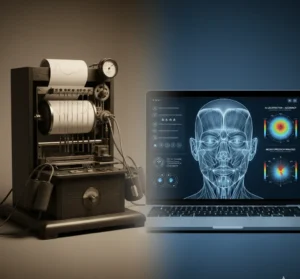
Before you book a test, it helps to understand one thing: a polygraph is a tool, not a magic device. It closes some questions and leaves others wide open. So do you need a polygraph in your case? This article walks you through the six most common situations in which people reach for a lie detector, and gives you a clear answer: when the polygraph will work, when it will only waste your time and money, and when there are alternatives that deliver a result faster and cheaper.
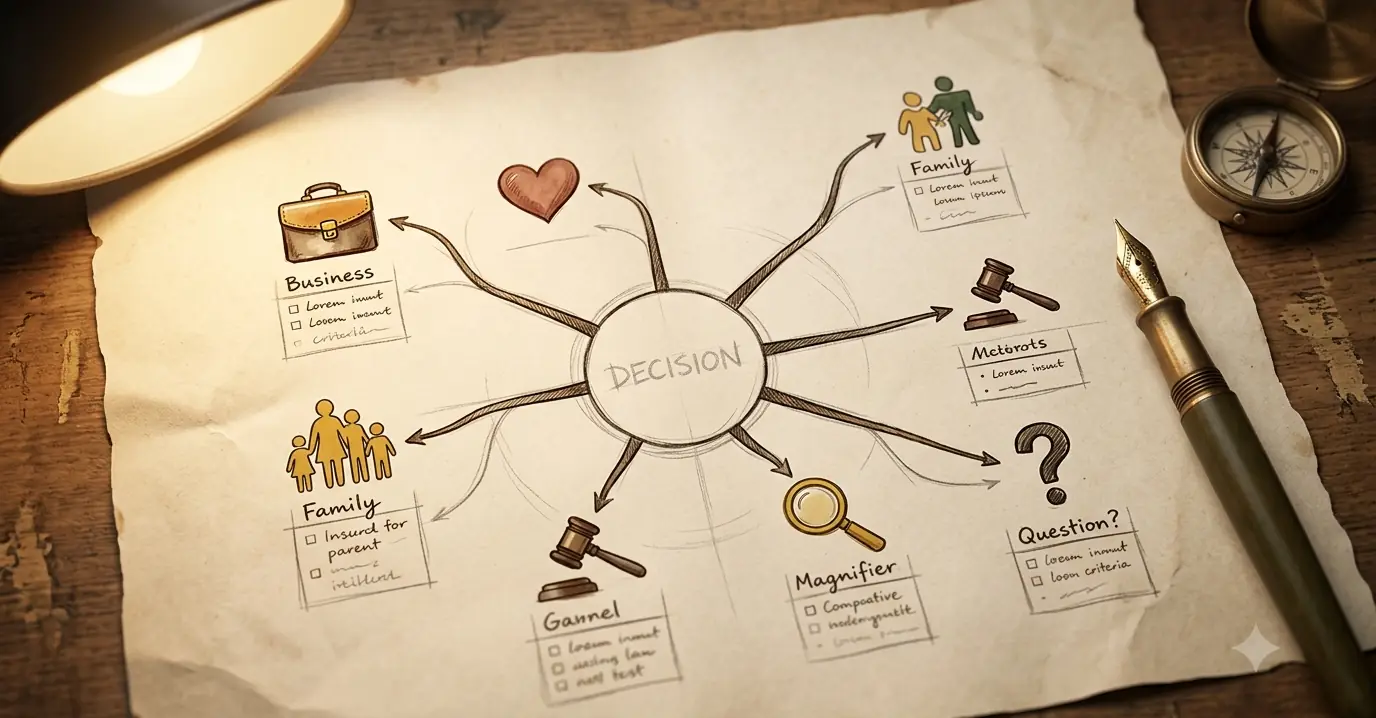
Quick test: If you have a specific question that needs a yes/no answer from another person who has given consent, the polygraph will work. If you are looking for "the truth about someone's entire life," "proof of their general attitude," or "confirmation of a gut feeling with no facts behind it," then no — the polygraph will not give you that.
In this article we cover six scenarios: suspected infidelity, screening a job candidate, a family dispute (inheritance, custody), a legal process, personal doubt (intuition versus facts), and a corporate internal investigation. For each one you get clear "when yes, when no" criteria, the results you can expect, the alternatives, and a rough price. At the end there is a comparison table and an FAQ.
Statistics: who takes a polygraph in Ukraine, and why
According to estimates from the Ukrainian Association of Polygraph Examiners, roughly 45,000–55,000 tests were carried out in Ukraine in 2024 (not counting the government sector). The main client categories break down like this: corporate clients — 55–60% (candidate screening, internal investigations, periodic staff checks); private individuals — 30–35% (suspected infidelity, family disputes, personal doubts); legal cases — 10–15% (expert examinations in civil and criminal matters).
The most active category among corporate clients is the banking sector and financial institutions (about 30% of corporate orders), followed by retail and logistics (25%), then IT and telecom (15%), construction (10%), with the remaining industries sharing the rest. Among private cases, more than 60% involve suspected infidelity by a partner, 20% are family inheritance and custody disputes, 15% are personal doubts with no clear target, and 5% are miscellaneous (suspected theft by household staff, vetting a nanny, and so on).
In practice, the success rate of the diagnosis — that is, getting a clear answer the client can act on — depends heavily on the scenario. In corporate investigations tied to a specific incident, the success rate is 90–95%. In candidate screening it is 85–90%. In suspected infidelity backed by specific indirect signals it is 85–90%. In personal doubts with no clear target it drops to 50–60%, because most of these cases turn out to be unsolvable by polygraph: the real problem lies not in the facts but in the client's own inner state. In inheritance disputes it is 75–85%, depending on how willing all parties are.
These figures give you an important insight: the polygraph is a powerful tool, but far from a universal one. In 30–40% of inquiries a qualified examiner actually talks the client out of the procedure, because it is clear that in this particular case the test will not deliver the answer the client is hoping for. That is honest practice, and it is exactly the foundation of the decision-making method described below.
Before you decide whether you need a polygraph — three universal conditions
A polygraph works only when three conditions are met. If even one of them is missing, do not rush to book — solve that condition first.
Condition 1: there is a clear, specific question
"Did you take UAH 50,000 from our joint account on 12 May?" — good. "Were you sincere with me throughout our entire marriage?" — bad. The polygraph works with narrow, factual questions about specific events. Broad ones — "do you love me," "have you always been faithful," "do you take this seriously" — are not for the polygraph.
Condition 2: the other person consents
Polygraph testing without the examinee's written, informed consent is legally invalid and technically impossible, because the sensors have to be attached to the body. If you cannot picture a conversation in which the other person agrees to take the test, it is worth first reading the separate guide on how to convince someone to take a polygraph.
Condition 3: you are ready to accept any result
The polygraph may reveal a truth you do not want to hear. Before you order a test, answer yourself honestly: will you act on the result? If the "truth" changes nothing anyway — because you have already made up your mind regardless of the facts — the test will only add pain without changing the situation.
How to choose among the six main scenarios
The six scenarios below cover about 95% of real-world inquiries. If your situation does not fit neatly into one of them, it is most likely a combination of two or three (for example, a corporate investigation with a legal element, or a family dispute with an element of personal doubt). Read through all the scenarios carefully, because your case may call for several different approaches.
The general decision-making approach: work out which scenario best describes your situation, judge how specific your question is, check the universal conditions and the scenario-specific ones, estimate the cost and time, and plan your next steps. This structured approach sharply reduces the risk of a mistake or wasted spending. If you are unsure which scenario fits, we can analyze your situation together in a free preliminary consultation and settle on the most sensible course of action.
In 30–40% of cases the analysis shows that a polygraph is not the best option for your particular case — and we will tell you so honestly, even if it means we do not get the client. That is part of our approach: better to lose one customer than to bring someone in for a procedure that will not close their question. For those with a complex, ambiguous situation, we also offer alternative routes — psychological counseling, legal examination, mediation — when they fit your case better than a polygraph.
Scenario 1: suspected infidelity by a partner
The most common private case. Whether the polygraph will work here depends on how specific your questions are.
When the polygraph will work
You have a specific suspicion: "Did you have physical contact with [name] over the past year?", "Did you send messages of an intimate nature to anyone other than me in the past month?", "Were you at the [name] hotel on [date]?". Your partner agrees to take the test voluntarily — a crucial condition, with no pressure, threats, or ultimatums. And you are ready to accept the result and act on it.
In that case the accuracy of the answer is 87–95%. The standard procedure lasts 1.5–3 hours and costs UAH 3,500–7,000 in Ukraine. The examiner's report can be used in court (as a reference point) in a divorce that involves a property dispute.
When the polygraph will not work
The questions are general ("do you love me," "do you value our family," "have you been honest"). The partner refuses — in which case any result will be doubtful, because coerced consent psychologically shifts the reaction. Or you have no plan to act on the result and simply "want to know." In these cases the money spent on the polygraph will be wasted, emotionally and financially.
Alternative
For a first pass — an online polygraph through StimulTest. It is cheaper (from $50), you do not have to go to the office together, and it is psychologically less stressful. It gives a preliminary answer with 78–88% accuracy. If the result needs confirmation for legal purposes, you can then move on to a classic polygraph.
Scenario 2: screening a job candidate
A corporate case. HR or the security team wants to vet a candidate for a key position — chief financial officer, treasurer, an IT admin with access to critical systems, or a role carrying material responsibility.
When the polygraph will work
The position is genuinely key (the loss from a dishonest employee runs into tens of thousands of dollars or more). The questions are tailored to the specific company: "Are you concealing the reasons you left your last job?", "Do you have an unspent conviction that you hid from your CV?", "Have you committed any workplace theft in the past 5 years?". The candidate signs a consent form — without pressure, as a standard part of the hiring process.
The cost is UAH 3,500–5,000 per candidate. A corporate rate (from 5 people) is cheaper. The report is delivered to the client in a sealed envelope, and, at the candidate's request, a copy goes to them personally. Accuracy is 87–95%.
When the polygraph will not work
The position is routine (a cashier, an operator, a rank-and-file manager) — the test costs more than the potential loss from a hiring mistake. The questions are general ("will you be loyal," "do you plan to stay long") — the polygraph does not measure future intentions. Or there is a large flow of candidates (50+ a month) — mass screening with a classic polygraph is not cost-effective.
Alternative
For mass screening — an online check with StimulTest. It is remote, cheap (from $30 per candidate on the corporate rate), and fast (30–60 minutes per candidate). It lets you filter out 80–90% of potentially problematic candidates. A final check of your top 5 candidates can then be done with a classic polygraph. There is more on the StimulTest for companies page.
Scenario 3: a family dispute — inheritance, custody, finances
This is a specific category: several family members have a conflict of interest, and you need to establish concrete facts (who received the money, who owned the property, who was drinking on a particular day).
When the polygraph will work
The dispute has concrete, factual content: "Who received UAH 200,000 in cash from Father in 2024?", "Was a certain bank deposit opened with the spouses' joint funds?", "Did one of the parents drink alcohol in the child's presence over the past year?". All parties involved voluntarily agree to be tested (this is often a necessary condition — and often the hardest part). And the result will be used in a court process or in an out-of-court settlement.
When several family members are tested, the cost is calculated individually (usually UAH 4,000–6,000 per person, with an escalating discount for a corporate-style package). The procedure lasts 2–3 hours per person.
When the polygraph will not work
The dispute is about "general fairness" ("was Dad right to leave everything to my brother"), about judging moral behavior ("is my sister acting badly"), or about assumptions with no concrete facts. Or one of the parties refuses — the voluntary element breaks down, and the result will be legally weak.
Alternative
A consultation with a family lawyer. In most cases the facts (who received the money, who owned the property) can be established through documentary evidence — bank statements, notarized documents, witnesses — with no need for a polygraph.
Scenario 4: a legal process — court, investigation, expert examination
The most complex scenario in terms of formalities. Here the polygraph is used as expert support for a lawyer or a party to a dispute.
When the polygraph will work
You have a civil claim (for example, contesting an inheritance, a property dispute, or a divorce with a custody battle) where you need to strengthen a party's position. Your lawyer recommends a psychophysiological examination as additional evidence. The examination is ordered from an accredited specialist (with a university degree, APA or APP certification, and 5+ years of experience). The written report is drawn up in line with procedural requirements.
The examination costs UAH 5,000–10,000 in Ukraine (higher than a standard test because of the formal write-up of the report). The report includes a description of the methodology, the results, and the expert opinion. In some cases the examiner is called to court as a witness.
When the polygraph will not work
A criminal process in Ukraine — the polygraph is not standalone evidence, only a reference point. Spending money on "evidence for the court" in a criminal case will be wasted as far as the formal process is concerned. And in civil cases where there is another way to prove your position (documents, witnesses, a different examination), the polygraph will be redundant.
Alternative
Before ordering an examination, consult your lawyer. In 70% of civil cases a polygraph adds less to your position than skilled work with documents and witnesses. It is worth considering when the other evidence is exhausted or substantially weaker.
Scenario 5: personal doubt — intuition versus facts
"I feel something is wrong, but I have no proof. I want at least one confident answer." This is the most sensitive category, and the one where a polygraph is often the wrong choice.
When the polygraph might work
Your intuition rests on specific indirect signals (a change in your partner's behavior over a particular period, strange financial transactions, information from third parties). You can formulate a specific question you want a yes/no answer to. And you are ready to act on the result.
When the polygraph will not help
The doubt has built up over a long time, with no external triggers — that is often more about you and your inner state than about the other person. In that case the truth (even if it is in your favor) will not lift the doubt, while a different truth would only bring more problems. Here psychotherapy works better than a polygraph.
You want "proof of a general attitude," "confirmation of love," "certainty of devotion" — the polygraph does not measure feelings. It measures reactions to specific facts.
Alternative
A conversation with a psychologist or family therapist. In 60% of cases where people come in saying "I want to test my partner on a polygraph," the real problem is not infidelity but a loss of trust for other reasons — crises in the family, estrangement, unresolved grievances. A polygraph will not solve that.
Scenario 6: a corporate internal investigation
An incident has occurred: a shortage of goods in the warehouse, a client database leaked to a competitor, a corruption incident. The circle of suspects is known (5–20 employees). You need to find out who is involved.
When the polygraph will work
The incident is specific and has a specific date and place. The circle of suspects is limited (up to 20 people). Each of them agrees to be tested voluntarily (important: a refusal should not automatically be treated as "guilt," but it is a strong signal for further analysis). And you have a budget for a series of tests (UAH 3,500–5,000 per person × the number of suspects).
In cases like these the polygraph is 90%+ effective at identifying those involved. The report is used to guide the further internal investigation, not as the sole evidence for dismissal.
When the polygraph will not work
The incident is vague (constant shortages with no specific episode). The circle of suspects is large (50+ people). The team strongly resists the check, and refusals are widespread. Or you want to "scare" people with the very fact of a test — that works as a short-term effect, but it creates long-term loyalty problems.
Alternative
For the first phase (narrowing the circle of suspects from 20+ down to 3–5) — an online screening through StimulTest. It is fast, relatively cheap, and does not require a direct accusation up front. The 3–5 people it flags can then be sent to a classic polygraph for an expert report.
Comparison table: the 6 scenarios
| Scenario | Will it work? | Cost, UAH | Recommended format |
|---|---|---|---|
| Suspected infidelity by a partner | Yes, if the questions are specific | 3,500–7,000 | Online → then in person |
| Candidate screening | Only for key positions | 3,500–5,000 | Online for mass screening; classic for the top 5 |
| Family dispute | Only if all parties agree | 4,000–6,000 × number of people | Classic polygraph |
| Legal process | Civil — yes; criminal — limited | 5,000–10,000 | Classic expert examination |
| Personal doubt | Often no — try therapy first | 3,500–5,000 | A psychologist first |
| Corporate investigation | Yes for a specific incident | 3,500–5,000 × circle of suspects | Online → classic |
Real cases: how it works in practice
Theory explains the principles well, but real understanding comes through examples. Below are three anonymized cases from our practice that show how the decision about a polygraph shapes the outcome.
Case 1: a success — a corporate investigation
A Kyiv logistics company with a turnover of UAH 280 million a year recorded systematic shortages of goods — about 3.5% of turnover. The cameras did not give a clear picture, because the shortages showed up during receiving and write-offs. Suspicion fell on 8 warehouse staff and 2 managers. The client came in with a clear brief: find out who was involved in specific episodes of shortage on 4 dates in the last quarter.
The examiner tested 10 employees over 5 days. The questions were framed narrowly: "Did you remove goods without filling out a waybill on date X?", "Do you specifically know who did this?". The results identified two employees whose reactions showed deception on the specific questions. In the follow-up conversation, both confessed. The total saving for the business was around UAH 1.4 million a year (an 80% cut in shortages after the two employees were dismissed and tighter controls were introduced).
Case 2: a mistake — trying to test "general faithfulness"
A 38-year-old woman came in suspecting that her husband was "not entirely faithful" — with no specific signals, only a feeling. During the preliminary consultation the examiner tried to pin down concrete facts: was there a suspicion about a particular person? A specific period? Specific behavioral changes? The client insisted: "Just check whether he was faithful throughout the whole marriage."
The examiner declined to run the test in that wording. The reason: "faithfulness across the whole marriage" is too broad a concept, spanning hundreds of small episodes over 12 years. A reaction to such a generalized question yields no useful information — almost every marriage has minor episodes that can trigger an uneven reaction (a long-ago brief attraction at an office party, a careless glance, and so on), which would be wrongly read as "infidelity." The client was referred to a psychotherapist to work through her own anxiety. Six months later the woman came back and reported that therapy had indeed uncovered the root cause — unresolved grievances from the past, unconnected to her husband.
Case 3: a borderline case — an inheritance dispute
A brother and sister could not agree on how to divide an apartment after their father's death. The brother claimed that two years before his death the father had handed him UAH 250,000 in cash "against his future inheritance." The sister did not believe it. The lawyers recommended mediation, but both sides were emotionally involved.
At the consultation the examiner explained: the test will give an answer only if both sides voluntarily agree to take it and both accept any result. The brother agreed at once. The sister hesitated — and that was an important signal, because she did not want the result to be interpreted against her. After a week of thinking it over, the sister also agreed, but on the condition of a symmetrical approach: she would be tested on the question of whether she had hidden any gifts from their father. The symmetry removed the psychological discomfort.
The results: the brother showed a clear truthful reaction to the question about receiving the UAH 250,000 from his father. The sister showed a similar reaction to her own questions. The dispute was resolved without a court trial, in out-of-court mediation. Both signed a settlement agreement. The legal costs, which could have run to UAH 80,000–120,000 in litigation through the courts, were held to UAH 25,000 for the examiner and the mediator.
Emotional preparation: what to expect before, during, and after the test
One of the least-discussed aspects is the psychological side of the process. Many people focus on the technical details and ignore their own emotions, which can later make it harder to accept the result.
A few days before the test
Normal feelings: anxiety, doubts like "what if I'm wrong about needing the test at all," occasional thoughts about the possible outcomes. This is not pathology but a healthy reaction of the brain to an important upcoming decision. Not normal: total panic, losing sleep for a week, aggression toward loved ones, overeating or refusing food. If you notice this in yourself, it is a signal that you should consult a psychologist before going to the test.
On the day of the test
Expect: moderate nervousness, a slightly quickened heartbeat, perhaps a little weakness. This is normal sympathetic activation — and it is exactly what the instrument will measure, in calibrated form. The pre-test interview (30–60 minutes) helps you get used to the setting and to the examiner as a person. Do not rush, and do not try to "pull yourself together" or "stay calm" — a natural reaction gives a cleaner result than an artificially suppressed one.
1–2 hours after the test
Almost all examinees go through a brief period of emotional emptiness: the accumulated tension "comes out," and a mild physical fatigue sets in. This is normal. Plan your day so that you have 2–3 hours of quiet after the test. Do not make important decisions right away — even if you have your result and think you know what to do.
1–3 days after the result
This is the period of processing. If the result confirmed the suspicion, there is a natural shock (even when you "knew"), followed by planning your next moves. If the result dispelled the suspicion, there is relief, joined by a rethinking of your own reactions (how did I even reach the point of doubting). In both cases a short consultation with a psychologist or a trusted person helps as emotional support.
How to choose an examiner: 7 quality criteria
The quality of the result depends directly on the specialist's qualifications. In the hands of an amateur, a polygraph can produce faulty results even when the examinee is telling the truth. Here are the key criteria to watch for.
1. Certification
The examiner should have documented training: specialized courses from accredited programs (the Ukrainian Association of Polygraph Examiners, the American Polygraph Association). Without certification, the risk of amateur work rises sharply.
2. Experience — 5+ years of practice
Young examiners can be technically competent, but the quality of interpretation grows significantly with the number of tests conducted. Ideally, look for a specialist with 500+ tests in their portfolio.
3. Equipment from certified manufacturers
Serious examiners work on a Lafayette LX5000, an Axciton Vector, a Limestone Polygraph Pro, or similar American or European equipment. Cheap Chinese or homemade devices produce low-quality recordings, which lowers accuracy.
4. A written service contract
A serious examiner always works under a contract that clearly sets out the nature of the service, the turnaround time, the form of the report, confidentiality, and the rights and obligations of the parties. Working "on a handshake" is a red flag.
5. A transparent pricing policy
The price should be stated up front and not change midway through the process. "Pay extra for a more accurate analysis" is not normal practice. A standard test costs UAH 3,500–7,000 in Ukraine.
6. Willingness to provide references
An examiner who has been on the market for 5+ years has corporate clients, partner lawyers, and partner psychologists. If you ask for a recommendation, you can contact the Ukrainian Association of Polygraph Examiners for a list of accredited specialists.
7. Your personal impression from the consultation
A free preliminary consultation is standard. Use it to judge whether the examiner asks clarifying questions about your situation (rather than immediately pushing a test), whether they explain the methodology and its limits, and whether they speak in measured terms about the likely result (rather than promising "100% accuracy"). The answers to these tell you a lot about their professionalism.
Red flags — when you definitely should not take a polygraph
- You want to "scare" the other person rather than learn the truth. That is manipulation, and it will wreck the relationship.
- The other person flatly refuses and you plan to apply pressure. Without genuine consent, the result will be legally and psychologically invalid.
- You are taking antidepressants or heart medication, or you are in a phase of acute stress. First stabilize your condition, then take the test.
- You want questions like "does he love me," "does she value our friendship." The polygraph does not measure that.
- You plan to pay for the test but have no plan for "what next" with the result. Emotionally costly, financially wasted.
Green flags — worth trying
- You have a specific factual question that needs a yes/no answer.
- The other person is willing to be tested voluntarily and without pressure.
- You have drawn up a plan of action for both possible outcomes in advance.
- You treat the polygraph as one tool among several, not as the single source of truth.
- You have the budget (UAH 3,500–10,000) and the time (1–3 hours).
Common mistakes when deciding on a polygraph
Based on an analysis of hundreds of client consultations, a few typical mistakes stand out that get in the way of a useful result. Avoiding them will significantly raise the chances that the test gives you exactly the answer you are counting on.
Mistake 1: treating the polygraph as an "all-knowing detector"
A common belief: "the machine will tell me the whole truth." The reality: the polygraph answers only the questions it is asked. If the question is framed as "were you faithful," the machine will answer that exact wording — and it can be ambiguous, because different moments in a relationship fall under "faithfulness" in different ways. Narrow your questions down to the utmost specificity: "did you have physical contact with [specific person] on [specific date]."
Mistake 2: ignoring your own emotions at the decision stage
People often go for a polygraph with a hot head — after a fight, in a state of acute anxiety, at the peak of a relationship crisis. That is not ideal. The best time to decide on a test is once you have let out the first wave of emotion, analyzed the situation, and clearly formulated the question. If you decide on a test while angry, you probably will not calmly accept a result that reveals a truth you do not like.
Mistake 3: not planning the "next step"
"I'll take the test and then figure it out" is a common approach that often leads to poor decisions. It is better to spell it out in advance: "If the result shows A, I'll do X. If B, I'll do Y. If it's inconclusive, I'll do Z." This takes half the emotional load off the result itself and lets you act deliberately.
Mistake 4: pressuring the other person to consent
If you need to test a partner or family member and their consent was obtained "under pressure" (a threat of divorce, an ultimatum, manipulation), then even formally documented consent is psychologically invalid. Such a person will come to the test with off-the-charts stress, and the results will be less reliable. Allow time for genuine, voluntary consent — even if that means weeks of waiting.
Mistake 5: using the polygraph to avoid a serious conversation
Sometimes people go for a test so they do not have to talk to their partner or relative directly first. This is almost always a bad strategy. The polygraph is a tool for confirming or refuting specific suspicions, but it does not replace a dialogue. Without an honest conversation with the other side about your anxiety and the possible ways to resolve it, even the most accurate test result will not solve the underlying problem.
How to combine the polygraph with other tools
The polygraph is rarely the only solution — it usually works best in combination with other tools. Let's look at the most common combinations.
Polygraph + psychologist: for emotionally complex cases
In cases of suspected infidelity or serious family disputes, parallel work with a psychologist significantly boosts effectiveness. The psychologist helps you formulate the questions correctly, prepares you to accept the result, and works through the emotional aftermath. The polygraph gives an objective answer on specific facts. This combination typically costs UAH 8,000–15,000 and takes 3–4 weeks (2–3 sessions with a psychologist + 1 test), but it delivers a far deeper result than either tool on its own.
Polygraph + lawyer: for procedural cases
In inheritance disputes, divorces with property claims, and corporate investigations, working with a lawyer is critically important. The lawyer formalizes the process correctly (the examination contract, the protocol, the documents), which guarantees the legal weight of the report. The examiner gives an expert opinion in the proper form. The lawyer then uses the report in negotiations or in court. The cost is roughly UAH 12,000–25,000 for the whole package (the examination plus the legal paperwork).
Online polygraph + classic: a two-stage check
For important cases where the result will carry serious consequences, the optimal strategy is a two-stage check. First an online check (specifically, StimulTest) as a preliminary screening — cheap, fast, remote. If the result is unambiguous, that is already enough. If it is borderline, or you need confirmation for serious decisions, you then move on to a classic polygraph. This two-stage model typically costs UAH 5,000–9,000 and gives many times more confidence in the result than a one-off check.
Polygraph + internal investigation: for corporate cases
In internal investigations, the polygraph is most effective as one of several parallel tools: a document audit (bank statements, waybills, access logs), video surveillance, witness interviews, and polygraph testing of suspects. Each tool covers a different aspect of the investigation — and consistency across the tools gives high confidence in the conclusion. In this model the polygraph is rarely the first step (that creates stress and resistance in the team) and is usually applied at stage 3 or 4, once the circle of suspects has been narrowed from 50+ to 5–10 key people.
What happens if you do decide to take the test
If, after weighing up all the red and green flags, you have decided to go ahead, it helps to know what the process looks like from booking to result.
Stage 1: booking and preliminary consultation (1–3 days)
Call or leave a request. A specialist gets in touch for a free preliminary consultation (15–30 minutes), during which they establish the nature of your situation, the possible wording of the questions, your physical and psychological state, and any chronic illnesses or medications. In the same consultation you choose the format: a classic polygraph in the office or an online check through the browser. A specific date and time are set.
Stage 2: preparation (1–2 days before the test)
The examiner sends you a short preparation guide: a full night's sleep beforehand, no alcohol for 24 hours, limited caffeine on the day of the test, and no sedatives without prior agreement. If you take regular medication, be sure to tell the examiner, because some drugs affect the readings.
Stage 3: the test itself (1.5–3 hours for the classic format, 30–60 minutes online)
Classic polygraph: you come to the office, and the examiner runs a pre-test interview (30–60 minutes) in which every question to be asked is discussed. The wording is agreed on. Then the sensors are attached and a practice test is run (10–15 minutes). The main testing (30–60 minutes) includes 3–5 cycles of questions. Then comes the closing conversation and a preliminary verbal result (10–15 minutes).
Online check: you log into the system through the browser at the appointed time, go through a short set of instructions (5 minutes), and then take the main test (20–40 minutes), responding to stimuli. The result is generated automatically in a report.
Stage 4: receiving the official report (1–3 days after the test)
For a classic polygraph, the written report is provided within 1–3 business days. It contains a description of the methodology, the profile of reactions, the expert assessment, and a signature and stamp. For an online check, the report is available immediately or within a few hours in your personal account.
What to do if the result surprises you or leaves you unsatisfied
Sometimes the result is not what you counted on. That can be unpleasant, but it does not necessarily mean a final answer.
If the result is "deception"
Do not panic. First read the detailed report — it may contain nuances. The reaction may have been triggered not by the fact of deception itself, but by accompanying emotional associations (for example, the person is ashamed of another aspect of the same topic, unrelated to your question). If in doubt, a repeat test with a different examiner and a modified methodology is recommended. In contested cases, it is combined with a FACS analysis of a video interview or with an online check for additional confirmation.
If the result is "truth" but you still do not believe it
This means the problem lies not in the facts but in your inner state. A polygraph that is 87–95% accurate has confirmed the truth — your doubts are not based on real physiological anomalies. That is a signal to work with a psychologist or a family therapist. A suspicion that does not go away even after an objective confirmation of innocence is a symptom that calls for a different tool of treatment.
If the result is "inconclusive"
This is the most difficult category. It usually means the examinee's reactions were either too weak (low reactivity), or too noisy (anxiety, conflicting emotions), or contradictory across different questions. The recommended strategy: pause for 1–2 weeks, then a repeat test with a modified methodology or in combination with an online analysis of reaction times. Sometimes the inconclusiveness is itself important information: it tells you the situation is more complex than it seemed.
What to do next
If, after reading this guide, you see that your situation falls under the "green flags," leave a request for a free preliminary consultation. Together we will analyze your specific case, advise on the format (online or classic polygraph), formulate precise questions for the test, and give you an honest assessment of how much the testing will help in your situation.
If your scenario is closer to the "red flags," do not spend money on a polygraph. In your case, other tools will most likely help: working with a lawyer, psychotherapy, mediation with the other side. Honest advice in a consultation is free, even if the outcome is us telling you not to order the test.
To sum up the key point. The polygraph is a tool with specific capabilities and limits. It handles narrow, situational facts well, provided the examinee consents voluntarily. It does not answer general questions of moral judgment, does not show "the whole truth about a person," and does not guarantee that the problem in a relationship will vanish after the test. Before you order a test, check the three universal conditions (a specific question, consent, readiness to accept the result), identify your scenario from the six described, and weigh the red and green flags. In 30–40% of cases an honest analysis will lead to the conclusion that a polygraph is not optimal for your situation — and that too is important information, one that saves you money, time, and emotional resources.
But if your scenario does fit a polygraph, choose the optimal format (classic for serious cases, online for prompt screening or a preliminary check), a qualified specialist judged by the 7 quality criteria, and plan your next steps clearly. Sound preparation gives the test the best possible chance to become a useful tool rather than an expensive emotional gamble.
We'll honestly assess whether a polygraph fits your situation and help you choose the format — classic or online StimulTest. Certified examiner, full confidentiality, online and in person. Leave a request — we reply within 15 minutes.
Latest articles