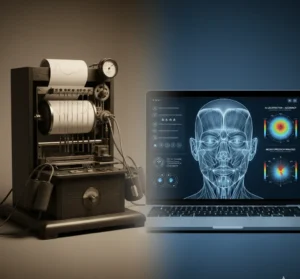
The question of how to beat a polygraph is one of the most popular searches among people preparing for a lie detector test. The internet is full of tips: put a tack in your shoe, think about something calming, take a sedative. But do these methods actually work? And what really happens when someone tries to fool the lie detector during a genuine examination?

Key fact: According to the American Polygraph Association (APA), a qualified examiner detects an attempted countermeasure in 95% of cases. And modern computer algorithms catch even the tiniest anomalies that are invisible to the human eye.
In this article, we take a close look at every known method of beating the polygraph, explain why they fail in most cases, and show why the online polygraph technology behind StimulTest — built on analyzing reaction times to masked stimuli — is virtually impossible to fool.
How a classic polygraph works: what it actually measures
To understand whether you can beat the lie detector, you first need to know what it measures. The classic polygraph records the body's physiological responses:
- Skin conductance (galvanic skin response) — changes with sweating triggered by stress or nervousness.
- Breathing rate and depth — monitored by pneumograph sensors on the chest and abdomen.
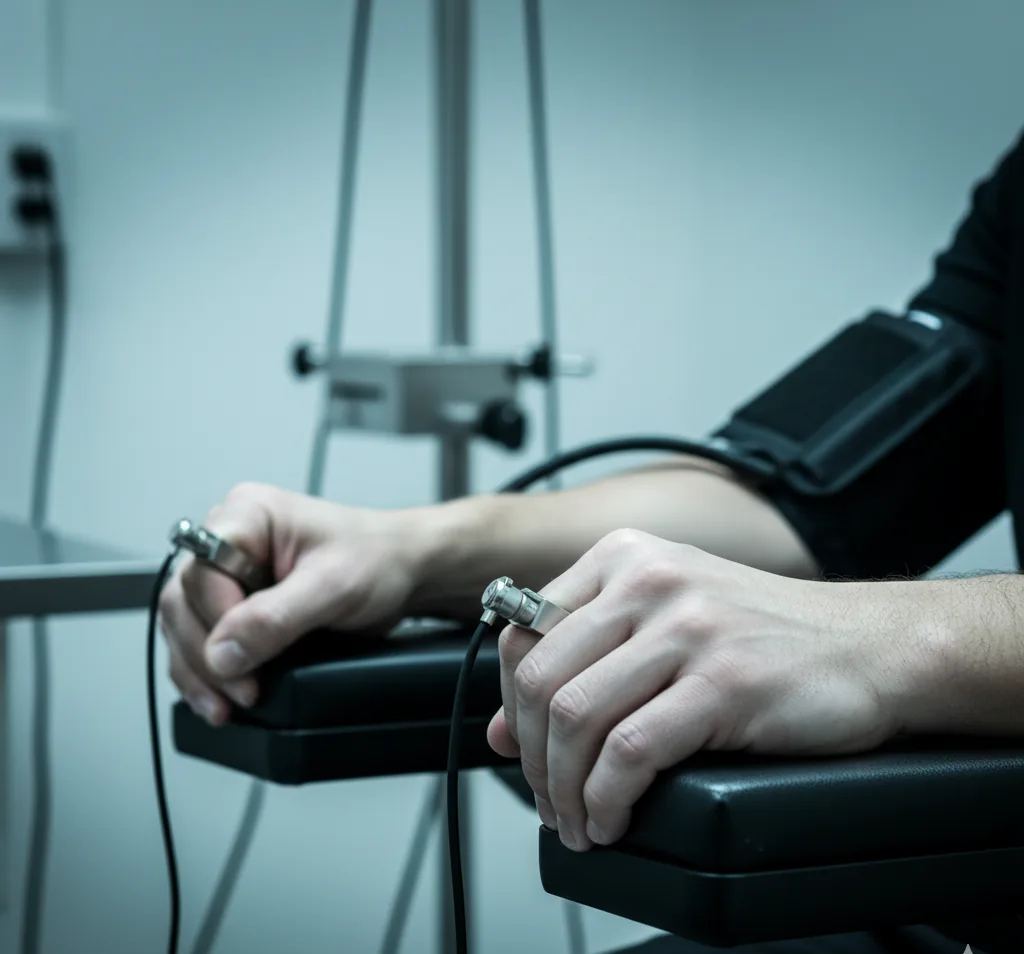
- Blood pressure and pulse — recorded by a cardio cuff on the upper arm.
- Motor activity — modern polygraphs include pressure sensors in the seat to detect micro-movements.
The logic is simple: when a person lies, they feel stress, and the body reacts involuntarily. Yet it is precisely this dependence on physiology that creates a theoretical vulnerability — if you learn to control your bodily responses, you might try to mislead the polygraph. That is why there is so much speculation around the idea of cheating the polygraph.
Method 1: Breathing control
The idea
One of the most common tips is to change your breathing rhythm during the critical questions. The idea is to artificially slow down or speed up your breathing to fake calmness, or, conversely, to create "noise" on the control questions.
Why it doesn't work
Modern polygraphs are fitted with two pneumograph sensors — one on the chest and one on the abdomen. The algorithm doesn't just record your breathing rate; it analyzes:
- the ratio of thoracic to diaphragmatic breathing;
- the duration of inhalation and exhalation;
- sharp changes in the breathing pattern;
- pauses and an abnormally even rhythm.
Any attempt to consciously control your breathing itself creates a telltale "unnatural" pattern that an experienced examiner spots immediately. What's more, artificial breathing requires cognitive effort, which affects the other channels — skin conductance in particular.
Important: If the examiner detects an attempt to manipulate your breathing, the test may be ruled uninterpretable, or the result may be read as a sign of countermeasures — which is effectively the same as admitting deception.
Method 2: Physical pain (a tack in the shoe)
The idea
Probably the most famous internet "life hack": place a tack or sharp object in your shoe and press on it during the control questions to create a "noise" physiological response that masks your real reactions to the relevant questions.
Why it doesn't work
First, most modern polygraphs are equipped with movement sensors in the seat. Even the slightest tension in the leg muscles as you press on the tack is registered as abnormal motor activity.
Second, a pain stimulus produces a specific response profile that differs from the profile of emotional stress. A pain reaction has a characteristic dynamic in the skin conductance channel, which the algorithm distinguishes from a reaction to a significant question.
Finally, an experienced examiner asks you to take off your shoes before the test, or checks them. This is a standard part of preparing for the procedure.
Method 3: Medications and pharmacological agents
The idea
Taking sedatives, beta-blockers, antiperspirants on the palms, or even narcotic substances to suppress the body's autonomic reactions.
Why it doesn't work
A study conducted by the U.S. Department of Defense in 2002 showed that none of the common pharmacological agents reliably conceal reactions on a polygraph. Here's why:
- Sedatives (benzodiazepines) — suppress reactions evenly across all questions, and the examiner sees abnormally flat curves. This immediately signals that medication is involved.
- Beta-blockers — reduce the heart rate but don't affect skin conductance or breathing. The reactions are still visible in the other channels.
- Antiperspirants on the palms — can reduce sweating, but the baseline level of skin conductance will be abnormally low, which draws the specialist's attention.
- Alcohol — alters behavior and cognitive function so much that the examiner immediately notices the impaired state.
Research note: A 2014 meta-analysis published in the journal Polygraph reviewed 57 studies and concluded that pharmacological agents do not produce a statistically significant reduction in polygraph accuracy when modern scoring methods are used.
Method 4: Mental tricks and psychological techniques
The idea
Picturing pleasant or unpleasant scenes while answering, counting backward in your head, meditating, or applying neuro-linguistic programming (NLP) techniques.
Why it doesn't work
The cognitive load of these mental exercises itself creates a physiological reaction. When a person answers a question and simultaneously tries to visualize something or count, the brain works harder — and this shows up as a longer reaction time, changes in breathing, and micro-movements.
Research by Professor Aldert Vrij of the University of Portsmouth has shown that additional cognitive load not only fails to hide lies but actually makes the signs of deception more visible. This is the so-called "cognitive overload effect": the brain simply cannot lie, control its reactions, and perform an extra mental task all at once.
A special case: meditation
Some sources claim that experienced meditators can control their autonomic nervous system well enough to beat the polygraph. It's true that studies show experienced meditation practitioners have a lower baseline level of stress reactions. However:
- A reaction to a significant question still occurs — even if it is less pronounced.
- The examiner calibrates the baseline individually — for a "calm" person, even a minor deviation is treated as significant.
- The number of people who can maintain a deep meditative state during a stressful interrogation is vanishingly small.
Method 5: Practicing with a polygraph in advance
The idea
Going through several trial sessions on a polygraph to get used to the procedure and learn to control your reactions.
Why it doesn't work
Practice can lower your overall anxiety. But it does not eliminate the specific reaction to a significant (relevant) question. The orienting reflex — the body's involuntary response to a stimulus linked to threat or significant information — works automatically and cannot be trained away.
Interestingly, in 2013 there was a precedent in the United States: Chad Dixon was convicted for teaching people polygraph countermeasures. A federal court found that this activity constituted a criminal offense involving obstruction of justice.
Method 6: Muscle tension and micro-movements
The idea
Secretly tensing muscles — the sphincter, toes, or tongue, for example — to create controlled stress and "level out" the reactions across different questions.
Why it doesn't work
As already noted, modern polygraphs have movement sensors. But even if the movement is extremely small, muscle tension creates characteristic artifacts in the skin conductance channel. The algorithm also tracks the correlation between movements and questions: if "noise" appears systematically on the control questions, that is a clear marker of countermeasures.
Tip: Instead of trying to beat the polygraph, the best strategy is to be honest. If you take the test voluntarily, your candor works in your favor. Learn more about preparation on the How StimulTest works page.
Method 7: Sociopathy and psychopathy
The idea
A common myth: psychopaths supposedly feel no guilt or fear, so the polygraph doesn't work on them.
The reality
Research shows that psychopaths do indeed have reduced autonomic nervous system reactivity. But this doesn't mean a complete absence of reactions. The polygraph doesn't measure "guilt"; it measures the orienting reflex — the response to a significant stimulus. Even a person without empathy recognizes a question connected to their real experience, and the brain reacts — albeit more weakly.
According to estimates from Harvard Medical School, a classic polygraph correctly identifies deception in people with antisocial personality disorder about 75–80% of the time — lower than for the general population (85–90%). But far from zero.
How modern systems recognize attempts at deception
Countermeasure detection technology has advanced considerably over recent decades. The modern arsenal includes:
Computer analysis algorithms
- Heart rate variability (HRV) analysis — detects the "unnatural" heartbeat characteristic of medication use or conscious control.
- Spectral analysis of breathing — distinguishes natural from artificial breathing by its frequency spectrum.
- Cross-correlation of channels — compares reactions across the different channels. In a natural reaction, all channels correlate; with artificial manipulation, "inconsistencies" appear.
- Response pattern analysis — artificially leveling out the reactions creates a statistically unnatural distribution.
Special tests to detect countermeasures
Experienced examiners use so-called "traps" — specially designed questions whose answer is known for certain, but whose reaction reveals the presence of countermeasures. For example, a question about your name or age: if a person shows a heightened reaction while answering truthfully, that is a sign they are trying to manipulate their reactions.
Real cases of attempts to beat the polygraph
History records several high-profile cases involving deception of the lie detector:
Aldrich Ames
A CIA agent who spied for the Soviet Union from 1985 to 1994. He passed the CIA polygraph twice — and both times the results were deemed satisfactory. However, a later analysis showed that the examiners made procedural errors, and Ames had received instructions from his intelligence handler. This case is often cited as an example of "beating the polygraph." But it was really an example of examiner human error, not a technical vulnerability.
Gary Ridgway
The "Green River" serial killer, who passed a polygraph in 1984. Later experts pointed out that the technology of the time was far less advanced and the testing methodology far less standardized. Modern algorithms with computer data analysis would be unlikely to produce the same result.
Research note: The report of the U.S. National Academy of Sciences (2003) acknowledged that the polygraph is "better than chance." But it recommended developing alternative methods of detecting deception that are less dependent on controllable physiological reactions. That is exactly the direction StimulTest technology pursues.
Why StimulTest is virtually impossible to beat
Unlike a classic polygraph, the StimulTest platform uses a fundamentally different approach to detecting deception — and it is precisely this approach that makes the system extremely resistant to countermeasures.
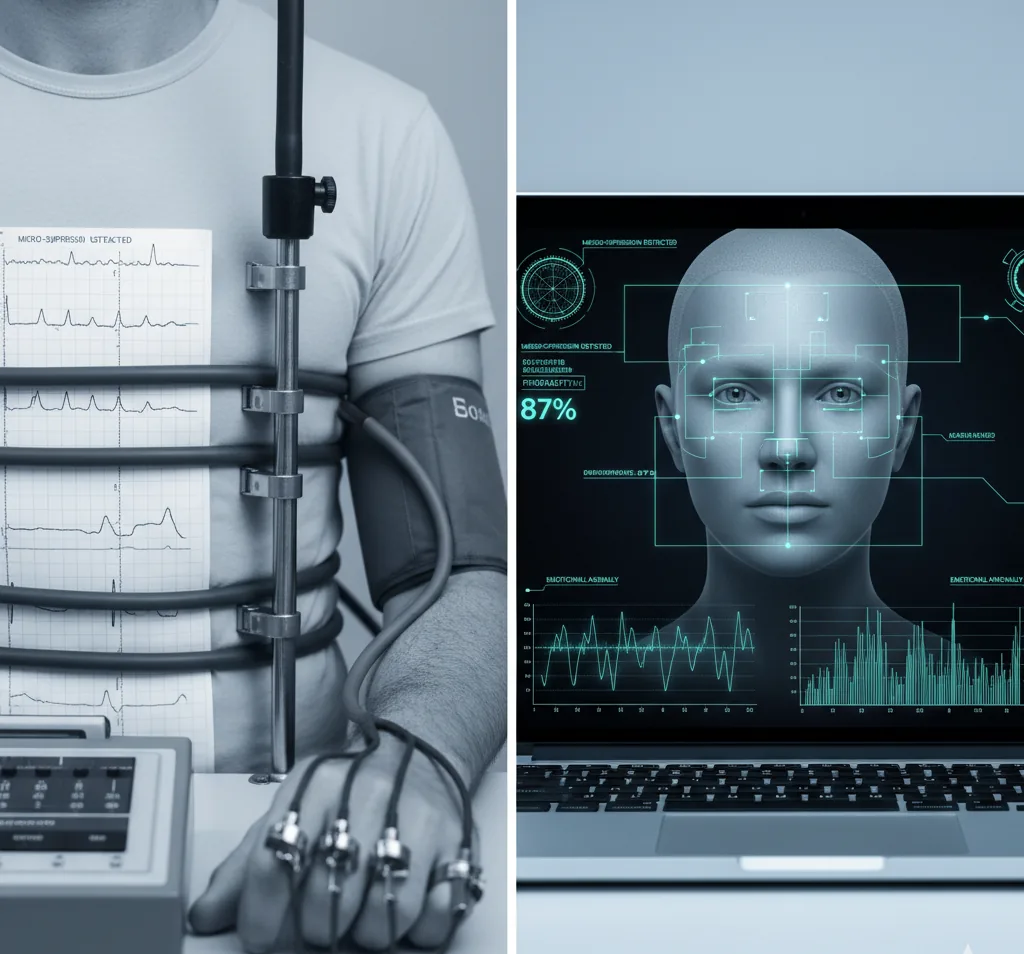
How it works: reaction time to masked stimuli
StimulTest is based on analyzing reaction times to specially prepared stimuli that appear on screen for fractions of a second. The key differences:
- Involuntariness. The reaction time to a subconsciously significant stimulus is an automatic brain response that happens before your conscious mind has a chance to "engage." You cannot consciously speed up or slow down your reaction to a stimulus you don't even have time to perceive.
- Masking of stimuli. The stimuli are presented so quickly and masked by neutral images that a person cannot tell which stimulus is "critical" and which is "neutral." Without that information, it's impossible even to know when to try to manipulate your reaction.
- Millisecond precision. The difference in reaction time between significant and neutral stimuli is measured in milliseconds. A person is physically incapable of controlling their reactions with that precision.
Why none of the "classic" methods work against StimulTest
| Countermeasure | Effect against a classic polygraph | Effect against StimulTest |
|---|---|---|
| Breathing control | Low: detected by sensors | None: breathing is not measured |
| Physical pain | Low: detected by movement sensors | None: no effect on reaction time |
| Medications | Low: detected by anomalous curves | Minimal: sedatives slow down all reactions evenly, so the difference between significant and neutral stimuli is preserved |
| Mental tricks | Low: cognitive overload | None: stimuli are presented subconsciously |
| Muscle tension | Low: detected by sensors | None: no effect on button-press timing |
| Practice | Low: the orienting reflex can't be trained | None: the subconscious reaction cannot be trained away |
The scientific basis
The reaction-time analysis method is grounded in decades of cognitive psychology. The Stroop effect, priming, and implicit association tests (IAT) all demonstrate that subconscious associations influence reaction time regardless of a person's conscious intentions. This research has been published in leading scientific journals: Psychological Science, the Journal of Experimental Psychology, and Cognition.
Learn more about the online polygraph and how it works on the "How StimulTest works" page.
Key advantage: Unlike a classic polygraph, StimulTest measures not the body's physiological reactions (which can theoretically be learned and controlled) but the brain's cognitive response (which cannot be controlled). This fundamental difference is what makes it resistant to any countermeasure.
Additional StimulTest advantages for protection against deception
The online format reduces the room for manipulation
Paradoxically, the remote format of StimulTest testing actually creates additional barriers to countermeasures:
- The person being tested doesn't see the questions in advance and doesn't know the structure of the test.
- They can't physically tamper with the equipment (as with the tack in the shoe).
- The camera captures micro-expressions and behavior during the test — an additional verification channel.
- The system automatically identifies anomalies in reaction time that indicate an attempt at manipulation.
A comprehensive approach to verification
StimulTest doesn't rely on a single data channel. The platform analyzes multiple parameters simultaneously: reaction time, response accuracy, the pattern of errors, and the dynamics over the course of the session. Manipulating one parameter inevitably creates an anomaly in the others — and the system records that automatically.
What the experts say about beating the polygraph
Leading specialists in deception detection are unanimous in their conclusions:
- Professor Gershon Ben-Shakhar, Hebrew University of Jerusalem: "The polygraph countermeasures described online are mostly based on outdated notions of the technology. Modern analysis algorithms are far ahead of these 'folk' methods of beating the test."
- Dr. Mark Handler, former APA president: "The biggest mistake a person can make is to prepare to beat the polygraph. Countermeasures are detected more often than they succeed, and being caught has more serious consequences than the test result itself."
How to prepare for a test the right way
Instead of searching for ways to cheat, we recommend focusing on proper preparation:
- Get a good night's sleep beforehand — fatigue lowers the quality of the baseline and can create false positives.
- Avoid stimulants — coffee, energy drinks, and nicotine can distort your physiological readings.
- Clarify the test format — contact the specialists at TestStimul for a free consultation.
- Be candid — this is the most effective strategy, confirmed by decades of research.
- Ensure the technical conditions — a stable internet connection, a good webcam, and a quiet room with even lighting.
Bottom line: can you really beat a polygraph?
In theory, it is possible to beat a classic polygraph — but in practice the odds are minimal. Modern equipment, computer algorithms, and examiner experience create a multi-layered system of protection against countermeasures. And for those looking for the most reliable, manipulation-proof verification tool available, there is StimulTest — a technology that works at the level of the brain's subconscious reactions, where human willpower simply has no access.
Can you beat a polygraph? The answer is no, provided the test is conducted correctly and the technology is modern. And beating StimulTest is impossible in principle, because you cannot control what you are not aware of.
Important: Trying to beat the polygraph is not only an ineffective strategy. It is also a risk to your reputation. A detected countermeasure is recorded in the report and is often read as a sign that the person has something to hide.
Don't waste time trying to beat the polygraph — pass an honest, expert check instead. Certified examiner, full confidentiality, online and in person. Leave a request — we reply within 15 minutes.
Latest articles