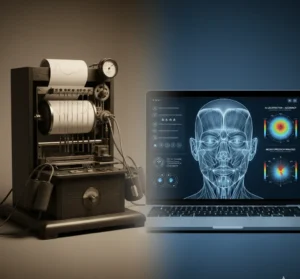
The legal status of the polygraph around the world differs dramatically from one country to the next. In Japan, the examiner's report has been admitted as full-fledged evidence in criminal proceedings for more than 60 years. In the United Kingdom, it is flatly rejected. In Israel, the polygraph is a standard part of hiring for sensitive government positions. In the EU, GDPR restrictions make its use problematic. In Ukraine, the picture is fragmented.

Key fact: The polygraph is admitted in the courts of 18 U.S. states (by consent), Japan, South Korea, Israel, and partially Canada. It is flatly rejected in the United Kingdom, Germany, France, and most EU countries. In Ukraine, it serves as a reference point in civil and corporate matters.
This article offers a comparative review of 14 key jurisdictions, complete with tables, lists, and clear recommendations. It will be useful to lawyers with an international portfolio, security directors at global companies, corporate HR teams, and private clients with cross-border family or business ties. The scientific basis of the method is described in the Wikipedia article on the classic polygraph.
Why regulation differs: three key factors
- Legal tradition. Common-law countries (the U.S., Canada, the U.K., Australia) are more open to expert evidence but constrained by precedent. Civil-law countries (Germany, France) are more conservative toward new technologies.
- Personal data protection. Europe's GDPR classifies physiological indicators as special categories subject to heightened protection. In the U.S., protection is weaker, leaving more room for use.
- Historical experience. Japan has used the polygraph since the 1950s; the U.K. still demands a clear scientific consensus that does not yet exist.
Master table: 14 jurisdictions
| Jurisdiction | In court | Corporate screening | Public sector | Cost |
|---|---|---|---|---|
| USA (18 states) | Yes, by consent | Limited by EPPA | Actively | $350–1200 |
| Canada | Limited | Limited | RCMP, police | CAD 400–1000 |
| United Kingdom | No | Rarely | Post-release | £400–900 |
| Germany | No (banned by the Constitutional Court) | Prohibited | No | — |
| France | No | Prohibited | No | — |
| Poland | As a reference | Allowed with consent | Investigations | €250–500 |
| Ukraine | As a reference | Actively, with consent | SBU, positions in the Ministry of Internal Affairs | UAH 3,500–7,000 |
| Russia | As a reference | Actively | FSB, select positions | RUB 8,000–30,000 |
| Israel | Yes | Actively | Military, intelligence services | ₪500–1500 |
| Japan | Yes | Limited | Police | ¥30,000–80,000 |
| South Korea | Yes | Actively | Police, prosecution | ₩500,000–1,500,000 |
| Mexico | Limited | Actively | Security agencies | MXN 3,000–8,000 |
| Argentina | No | Actively | Limited | ARS 30,000–80,000 |
| UAE | No | Actively in security | Actively | AED 1,500–4,000 |
Key jurisdictions — a brief breakdown
🇺🇸 USA — a fragmented picture
- EPPA 1988: private employers are prohibited from requiring a test. Exceptions: government, security firms, regulated pharmaceutical companies.
- States: 18 admit it in court by consent, 17 flatly refuse, and the rest leave it to the judge's discretion.
- Federal agencies: the FBI, CIA, DEA, and Secret Service use it actively in internal investigations and screening.
- EPPA penalty: up to $10,000 per case.
🇮🇱 Israel — the gold standard of acceptance
- Courts have admitted it in criminal proceedings by consent since the 1980s.
- It is a standard part of recruitment into the army and intelligence services (Shin Bet, Mossad).
- High methodological standardization, with mandatory certification through the official association.
- Regular publication of validation studies.
🇯🇵 Japan — a long-standing tradition
- Used in police practice since the 1950s.
- Admitted in criminal courts with the defendant's consent.
- The methodology is a modified CIT (Concealed Information Test) rather than the CQT — it works better in a culture with more restrained emotional expression.
- More than 100 certified polygraph examiners in the police force.
🇬🇧 United Kingdom — categorical non-acceptance in court
- Courts do not admit it in criminal proceedings (R. v. Mahoney 1973+).
- Since 2007 it has been mandatory for post-custodial supervision of sex offenders (once every 6 months).
- 2024: extended to those convicted of serious domestic offenses.
- Corporate use is rare because of strong trade unions.
🇪🇺 European Union — GDPR restrictions
- Article 9 of the GDPR: physiological data = special categories subject to heightened protection.
- Voluntary, with consent: permissible, but rarely admitted in court.
- Mandatory at work: categorically prohibited.
- Grounds for processing: explicit consent, vital interests, legitimate interest with a balancing test.
🇺🇦 Ukraine — fragmented regulation
| Area | Status |
|---|---|
| Criminal proceedings | Not standalone evidence; used as a reference |
| Civil proceedings | Increasingly used as corroborating evidence |
| Employment relations | Only voluntarily, with written consent |
| Public service | Mandatory for the SBU, select positions in the Ministry of Internal Affairs, and banks |
| Corporate use | Active in finance, IT, and roles with material accountability |
Latin America and Asia — additional details
| Country | Distinctive feature | Corporate use |
|---|---|---|
| Mexico | Federal courts — no. States — varies. | Especially in the northern states and the financial sector |
| Argentina | Not admitted in courts. | Banks, insurers, security |
| Colombia | Admitted in court on a limited basis. | Strong culture — part of hiring |
| India | Compulsory use is banned (Selvi 2010). Voluntary use, with consent, is allowed. | Banks, pharma, IT — actively |
| Australia | Not admitted in courts (Mallard 2005). | Limited |
| China | Actively used by police, not admitted in courts. | Limited |
| Singapore / Hong Kong | Not admitted in courts. | Active in banking and trading |
The historical evolution of regulation
- 1923 — Frye v. United States (USA): established the Frye standard for expert evidence.
- 1981 — Germany's Constitutional Court: ban on use in criminal proceedings.
- 1988 — Employee Polygraph Protection Act (USA): restrictions on private employers.
- 1993 — Daubert v. Merrell Dow (USA): the more liberal Daubert standard.
- 2010 — Selvi v. State of Karnataka (India): ban on compulsory use.
- 2014 — R. v. Hart (Canada): the possibility of admission as corroborating evidence.
- 2018 — GDPR (EU): physiological data as special categories.
- 2024 — EU AI Act: AI systems for detecting emotions and deception classified as "high risk."
Cross-border cases: 3 scenarios
- A corporate investigation in a multinational company. An incident at a Ukrainian office with reporting to the U.S./U.K.: conduct the test in the local jurisdiction and prepare the report with documentation for the parent jurisdiction. Dual certification of the examiner (APA + local) and an apostille may be required.
- A family dispute between citizens of different countries. Divorce, custody disputes, or inheritance involving assets in different countries. The choice of jurisdiction depends on where the case is adjudicated. If it goes to an EU court, choose Poland or Lithuania (higher acceptability).
- An immigration / asylum case. The U.S., U.K., and Australia use the polygraph in complex persecution cases. The report ($1,500–4,000 USD) strengthens the applicant's position.
Decision matrix: which jurisdiction to choose
| Your goal | Recommended jurisdiction | Why |
|---|---|---|
| Result → court (criminal) | Israel, Japan, Korea | Highest acceptability as evidence |
| Result → court (civil) | USA (18 states), Poland, Ukraine | Accepted as corroborating evidence |
| Corporate investigation | Ukraine, Poland, Latin America | Good quality + affordable cost |
| Personnel screening | Any non-EU country except the U.K. | GDPR makes the EU problematic |
| Immigration case | USA, U.K., Australia | Specialized examiners |
Trends 2026–2030
| Region | Trend | Implication |
|---|---|---|
| Europe | Tightening restrictions (EU AI Act 2024) | Mandatory certification of AI services by 2028 |
| USA | Further fragmentation among states | CA, IL, NY — stricter; TX, FL — more liberal |
| Asia | Broadening acceptance | Taiwan and Hong Kong may formalize acceptance |
| Ukraine | Movement toward a dedicated law | In the medium term (3–5 years) |
| Latin America | Caught between tradition and GDPR-like regulation | LGPD (Brazil) complicates corporate use |
International corporate compliance
Global companies with offices in different jurisdictions face specific challenges. The core principles:
- A global policy + local adaptation. The baseline principles (voluntariness, confidentiality, restricted access) are universal. The details are tailored to each jurisdiction.
- Data is stored locally. Results from a European branch must not be transferred to U.S. headquarters without aggregation — otherwise it is a GDPR violation.
- Dual certification of examiners. APA + a local association guarantees a consistent methodology.
- Standard document templates. Consent, contract, and results forms in the main languages.
- Regular policy audits — at least once a year, updated to meet new requirements (the EU AI Act and the like).
What to do next
If you have an international case and are considering the polygraph as a tool, start with a consultation. A free preliminary consultation will help you choose the right strategy: where to conduct the test, which format to use, and how to prepare the documents. Leave a request on the site.
If your case does not require legal weight — you need a check for a corporate investigation, candidate screening, or a personal doubt — the online polygraph StimulTest, in the form of a cognitive-load analysis, is available from any country. It removes the jurisdiction question entirely and delivers a result in 30–60 minutes.
Whatever jurisdiction your case touches, we'll help you choose the right approach. Certified examiner, full confidentiality, online and in person. Leave a request — we reply within 15 minutes.
Latest articles