A polygraph test makes most people anxious. And the main question that worries everyone getting ready for a session is: "what questions are asked on a lie detector?" What exactly will the examiner ask? Can you find out the list of questions in advance? Are there any trick questions among them that are impossible to answer correctly? This guide walks through the polygraph questions you can expect and why they are built the way they are.

Key fact: During a standard polygraph examination, 10 to 25 questions are asked, split into several series. Every question is carefully worded ahead of time and discussed with the examinee before the test begins — there should be no surprises.
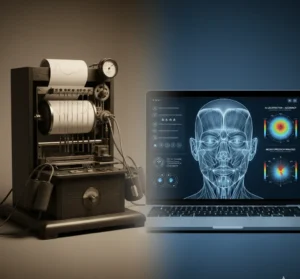
In this article we break down the types of polygraph questions in detail, give concrete examples for different contexts — from hiring to checking marital fidelity, from investigating theft to security screenings — and explain how the modern online polygraph StimulTest technology works in a completely different way, using disguised stimuli instead of direct questions.
The four main types of polygraph questions
Any professional polygraph test follows a specific methodology in which each question plays its own role. Whether the examiner uses the Control Question Technique (CQT) or the Concealed Information Test (CIT), all questions fall into four main types.
1. Irrelevant (neutral) questions
Neutral questions have nothing to do with the subject of the investigation and should not trigger any emotional reaction. They serve a technical function: they let the examiner establish the examinee's physiological baseline — that is, record what the person's reactions look like when they are not under stress and are answering truthfully.
Examples of neutral questions:
- "Is your name Alexander?"
- "Are you currently in Kyiv?"
- "Is today Monday?"
- "Are you over 20 years old?"
- "Are you sitting on a chair right now?"
The answers to these questions are obvious, and the examinee answers them truthfully and without anxiety. This lets the instrument record the body's "calm" state — a normal pulse, steady breathing, and stable skin conductance.
2. Relevant questions
Relevant questions are the key questions directly connected to the subject of the check. These are the ones the examiner analyzes the examinee's reactions to. If a person lies when answering a relevant question, their body reacts involuntarily — the pulse quickens, breathing changes, and skin conductance rises due to sweating.
Relevant questions are always worded clearly, unambiguously, and specifically. They cannot be vague or general — this is a fundamental rule of professional polygraph work.
Examples of relevant questions:
- "Did you take money from the company's cash register?" (in a theft investigation)
- "Did you have sexual contact with another person during your marriage?" (in a fidelity check)
- "Did you pass the company's confidential information to third parties?" (in a security check)
- "Have you used narcotic substances within the past year?" (during hiring)
3. Comparison (control) questions

Control questions (in modern terminology more often called "comparison" questions) are probably the hardest type to understand. They are deliberately worded so as to cause the examinee slight anxiety or uncertainty, even when the person is answering truthfully.
The logic is this: a control question touches on a general theme related to the investigation but far broader and less specific. Most people have, at least once in their lives, done something that a control question could cover — so when they answer "no," they feel mild discomfort.
The reactions to control questions are then compared with the reactions to relevant ones. If a person is telling the truth about the subject of the investigation, their reaction to the control questions will be stronger than to the relevant ones (because they answer the relevant questions confidently and honestly). If the person is lying, however, the reaction to the relevant questions will be significantly more intense.
Examples of control questions:
- "Have you ever taken something that belonged to someone else without permission?" (in a theft investigation)
- "Have you ever deceived a person who trusted you?" (in a fidelity check)
- "Have you ever broken confidentiality rules at work?" (in a security check)
- "Have you ever done something you would be ashamed to admit to management?" (during hiring)
Tip: Control questions are not a trap. Their purpose is to create a "reference" reaction for comparison. If you are telling the truth about the main subject of the check, control questions work in your favor: the difference between the reactions will confirm your truthfulness.
4. Sacrifice relevant questions
Sacrifice questions are a special subtype of relevant questions placed at the start of the test. They are called "sacrifice" questions because the examiner does not analyze the reactions to them — they are "sacrificed." The goal is to let the examinee get used to the subject of the investigation, lower the initial level of anxiety, and obtain cleaner reactions in the following series.
Example: "Do you know why you were invited to this examination?" or "Do you understand that the test concerns the incident of the missing funds?"
How questions are worded: rules and principles
Professional question wording for the polygraph is a science in its own right. There are a number of strict rules that every qualified examiner must follow.
The rule of unambiguity
Each question must have only one possible interpretation. Ambiguous wording, metaphors, and complex grammatical constructions are forbidden. The question "Have you ever done something bad?" is unacceptable, because the notion of "bad" is subjective. Instead: "Have you ever stolen money from an employer?" — specific and unambiguous.
The "yes/no" rule
All questions on a lie detector are worded so that the answer can only be "yes" or "no." Elaborated answers are not used — the polygraph analyzes the physiological reactions at the moment of the short answer, not the content of a story.
The rule of prior discussion
A key principle of professional polygraph work: every question is discussed with the examinee before the test begins. No surprises. The examiner reads out all the questions, checks that everything is clear and there are no ambiguities. If the examinee has objections, the question is reworded.
Good to know: If an examiner refuses to show you the questions in advance or asks unexpected questions during the test, that is a serious breach of professional standards. Such "specialists" should not be trusted.
The single-fact rule
Each question must concern only one specific fact or action. "Double" questions are forbidden: "Did you steal money or documents?" is unacceptable, because those are two different facts. The correct approach: "Did you steal money from the cash register?" and separately: "Did you take documents out of the office?"
The time-frame rule
A question must have a clear time frame. Not "Have you ever used drugs?" (too broad — it covers a whole lifetime), but "Have you used narcotic substances within the past two years?" — a specific period that can be verified.
Sample questions for different situations
Now let's look at concrete examples of polygraph questions for the most common check contexts.
Polygraph during hiring
A pre-employment polygraph test is one of the most common procedures, especially for positions involving finances, security, or confidential information. The client is usually the employer company.
Typical questions:
- Neutral: "Are you currently in this room?"
- Relevant: "Did you provide truthful information in your resume about your work experience?"
- Relevant: "Have you ever been fired from a job for a disciplinary violation?"
- Relevant: "Have you used narcotic substances within the past 12 months?"
- Control: "Have you ever told a lie to a manager?"
- Relevant: "Do you have a criminal record that you did not disclose to the employer?"
- Control: "Have you ever taken someone else's property, however minor?"
- Relevant: "Do you plan to use this position for unlawful gain?"
Polygraph in a theft investigation
Theft investigations are a classic use case for the lie detector. In such cases the questions are as specific as possible and concern a particular incident.
Typical questions:
- Neutral: "Were you born in Ukraine?"
- Sacrifice question: "Do you know that the test concerns the disappearance of 50,000 hryvnias from the cash register on March 15?"
- Relevant: "Did you personally take the money from the cash register on March 15?"
- Control: "Before this incident, had you ever taken someone else's money without permission?"
- Relevant: "Do you know who took the money from the cash register?"
- Control: "Have you ever hidden important information from management?"
- Relevant: "Did you help someone take the money from the cash register?"
- Neutral: "Are you sitting on a chair right now?"
Polygraph for checking marital fidelity
A fidelity check is a sensitive topic that private individuals turn to more and more often. In such cases the questions concern specific actions and have clear time frames.
Typical questions:
- Neutral: "Is your name [name]?"
- Relevant: "Have you had sexual contact with another person since you got married?"
- Control: "Have you ever hidden important information about the relationship from your partner?"
- Relevant: "Are you keeping up a romantic correspondence with another person?"
- Control: "Have you ever deceived a loved one about your feelings?"
- Relevant: "Have you met one-on-one with a specific person [name] within the past six months?"
- Neutral: "Are you currently in this city?"
Important: Questions about fidelity are always worded with the spouses' agreements in mind. The examiner agrees on the wording with the client in advance to avoid ambiguity. Both sides must understand in the same way what is meant by "cheating."
Polygraph in security screenings
Security screenings are conducted for government agencies and large corporations. They aim to identify potential threats, information leaks, and ties to competitors or hostile structures. Such checks demand the utmost thoroughness and security standards.
Typical questions:
- Neutral: "Do you work at this organization?"
- Relevant: "Did you pass internal information to outsiders?"
- Control: "Have you ever broken confidentiality rules at any place of work?"
- Relevant: "Do you have contacts with representatives of competing organizations that you did not report to management?"
- Relevant: "Did you copy internal documents onto personal storage media?"
- Control: "Have you ever used work resources for personal purposes?"
- Relevant: "Have you received payment from people unconnected with your employer for carrying out your job duties?"
What the examiner measures while you answer
Understanding what exactly the polygraph records helps you better grasp the role of each type of question. As you answer each question, the examiner simultaneously tracks several channels of physiological data.
Skin conductance (GSR)
Sensors on the fingers measure microscopic changes in sweating. When a person is anxious or under stress, the sympathetic nervous system activates and stimulates the sweat glands. This happens involuntarily — it is virtually impossible to control the process consciously. A change in GSR after a relevant question is one of the most reliable indicators of deception.
Breathing
Two pneumographic sensors — on the chest and on the abdomen — record the rate, depth, and rhythm of breathing. Under stress, the following are typical: holding the breath after a question, a shallower inhalation, a disrupted rhythm, or, conversely, an atypical "deliberate" control of breathing, which is also a diagnostic sign.
Cardiovascular activity
A blood-pressure cuff on the upper arm records changes in blood pressure and heart rate. The typical reaction to a significant question is an accelerated pulse and a rise in blood pressure. Modern polygraphs analyze not only average readings but also the micro-variability of the heart rhythm — a subtle parameter reflecting the balance between the sympathetic and parasympathetic nervous system.

Motor activity
Pressure sensors on the seat and footrest record micro-movements of the body. This data matters for two reasons. First, motor artifacts can distort the other channels and must be taken into account during analysis. Second, attempts at physical countermeasures (for example, tensing the muscles) are detected precisely through this channel.
How reactions are compared
The examiner does not simply check "whether there was a reaction." They compare the intensity of the reactions to different types of questions using numerical algorithms. In the CQT technique, the main comparison is between control and relevant questions. If the reaction to a relevant question statistically significantly exceeds the reaction to a control one, that is a sign of deception (DI — Deception Indicated). If it is the other way around, the person is probably answering truthfully (NDI — No Deception Indicated).
Tip: Do not try to "control" your reactions during the test. Artificially suppressing physiological reactions itself creates characteristic patterns that modern algorithms recognize as an attempt at countermeasures. The best strategy is to answer truthfully and calmly.
Common polygraph questioning methods
The choice of methodology determines the structure of the test, the number of questions, and their order. Here are the main approaches used by modern examiners.
Control Question Technique (CQT)
The most widespread methodology in commercial and law-enforcement practice. It is based on comparing reactions to control and relevant questions. The test usually includes 10–15 questions, repeated across 3–5 series in a different order. Each series is called a "chart."
Concealed Information Test (CIT / GKT)
This methodology does not ask direct accusatory questions. Instead, it checks whether the examinee possesses information that only a person involved in the incident could know. For example, if a laptop was stolen from an office, the examinee is named different items in turn: "Do you know that a printer went missing from the office? A monitor? A laptop? A phone?" The involved person involuntarily reacts more strongly to the correct option.
The Utah Approach
A modification of the CQT developed at the University of Utah. It stands out for stricter standardization of the procedure and the use of numerical scoring algorithms instead of the examiner's subjective analysis. It is considered one of the most reliable methodologies, with an accuracy of over 90% according to independent research.
The Federal Zone Comparison Technique
Used primarily by US federal agencies. It stands out for its rigid structure: four relevant questions, four comparison questions, plus neutral and sacrifice questions. In total, 12–15 questions in each series.
What you should NOT be asked on a polygraph
The ethical code of polygraph work and the legislation of many countries clearly limit the topics that cannot be the subject of a polygraph examination.
- Political views and party affiliation — questions about voting, attitudes toward the government, or membership in political organizations are prohibited.
- Religious beliefs — faith, attitude toward religion, attending places of worship, and the like.
- Sexual orientation — no questions about gender identity or sexual preferences.
- Union activity — participation in unions, strikes, or collective actions.
- Racial or ethnic background — any questions that could be discriminatory.
- Health status — except in cases where it directly concerns the subject of the check (for example, the use of narcotic substances).
Attention: If an examiner asks questions from the categories above, you have every right to refuse to answer and to stop the procedure. This will not affect the result of a legitimate check but will indicate the specialist's lack of professionalism.
Limits of the classic polygraph: why questions are not a perfect method
Despite decades of research and refined methodologies, the classic polygraph has fundamental limitations tied precisely to the format of direct questions:
- The "false positive" effect — an innocent person can produce strong reactions to relevant questions simply out of fear of being wrongly accused. This is the so-called "Othello effect."
- Dependence on wording — even a minor change in the wording of a question can substantially affect the reaction.
- Cultural and language barriers — a question that is natural in one culture may be unclear or offensive to someone from another.
- Subjectivity of interpretation — despite numerical algorithms, the scoring of control questions remains partly subjective.
- The possibility of preparation — knowing the structure of the questions in advance, a person could theoretically "rehearse" their reactions.
It was precisely these limitations that spurred the development of fundamentally new approaches to verification — such as the StimulTest technology.
How StimulTest works without direct questions: a revolutionary approach
The StimulTest technology is a radically different approach to detecting deception that does not use classic polygraph questions and therefore does not carry their limitations.
Disguised stimuli instead of questions
Instead of asking direct questions and measuring the body's physiological reactions, StimulTest works with disguised stimuli — visual images, words, or pictures that appear on the screen for fractions of a second. The examinee sees these stimuli but does not consciously perceive their content — they go straight into the subconscious.
The system analyzes the reaction time to these stimuli with millisecond precision. If a stimulus is significant to the examinee (that is, connected to concealed information), the subconscious reacts to it differently — and this is reflected in a microscopic change in reaction time that cannot be controlled consciously.
Advantages of the disguised approach
- Countermeasures are impossible — a person cannot control reactions to stimuli they are not consciously aware of. This is a fundamental difference from the classic polygraph, where the examinee hears the question and can try to control their reactions.
- No "Othello effect" — since there are no direct accusatory questions, an innocent person does not experience the fear of a wrongful accusation.
- Independence from culture and language — visual stimuli need no translation and are perceived the same way by people from different cultures.
- Objectivity of scoring — the analysis of reaction time is carried out by an algorithm, without the specialist's subjective interpretation.
- Remote format — testing can be conducted online, without the specialist being physically present.
How it works in practice: Imagine that during a theft test StimulTest shows the examinee a series of images — various objects, among which is a picture of the stolen item. The examinee may not even notice it among the others, but the subconscious "recognizes" the significant stimulus — and the reaction time increases by a few milliseconds. The system records this.
StimulTest for different situations
The disguised-stimuli technology adapts to any check context:
- For business — screening candidates, investigating incidents, assessing loyalty.
- For private individuals — checking fidelity, resolving family conflicts.
- For government agencies — security screenings, clearance for classified information.
How to prepare for a polygraph examination
Whether you are taking a classic polygraph or StimulTest testing, there are a few universal recommendations.
- Get a good night's sleep beforehand — fatigue reduces cognitive function and can distort the results.
- Avoid stimulants — coffee, energy drinks, and nicotine change your physiological readings.
- Do not take sedatives — this is detectable and can be interpreted as an attempt at countermeasures.
- Ask to see the questions in advance — this is your legal right.
- Clarify any unclear wording — if a question seems ambiguous, say so.
- Answer honestly — this is the most effective strategy for passing any test.
FAQ: common questions about the polygraph procedure
Can I refuse to answer a particular question?
Yes, you have every right to refuse any question. However, refusing a relevant question usually means the test on that topic cannot be completed. Contact our specialists for a consultation about your rights.
How many questions are asked during the test?
A standard test includes 10 to 25 questions, split into 3–5 series (charts). Each series contains the same questions but in a different order. The total length of the procedure is 1.5 to 3 hours, including the pre-test interview.
Will I be asked about past crimes?
The examiner may ask control questions of a general nature (for example, "Have you ever done anything illegal?"), but cannot demand details and does not record your answers as a confession. Relevant questions concern only the specific subject of the check.
What happens if I get very nervous?
Anxiety before the test is completely normal. The examiner takes it into account when calibrating the baseline. That is exactly why a lengthy interview and a trial series are conducted before the test — so the examinee can adapt. In the StimulTest system, general anxiety does not affect the result, because it analyzes relative changes in reaction time rather than the absolute level of stress.
Can I find out the questions in advance?
Yes — and it is not just that you "can": it is a mandatory part of the procedure. A professional examiner always discusses all the questions with the examinee before the test begins. If that does not happen, it is a serious breach of standards.
How is StimulTest different from a regular polygraph?
StimulTest does not ask direct questions. Instead, it uses disguised visual stimuli that the examinee reacts to subconsciously. This rules out the possibility of countermeasures, reduces the stress of the procedure, and ensures objective scoring.
Is polygraph testing legal in Ukraine?
Yes, polygraph testing in Ukraine is legal provided the examinee gives voluntary consent. Polygraph results have the status of an expert opinion and can be used as supplementary evidence. In some government structures the check is mandatory when joining the service.
Conclusion: what you need to know about polygraph questions
Polygraph questions are not a random set of topics but a carefully engineered instrument in which each question performs its own function. Neutral questions establish the baseline, relevant questions check the key facts, control questions create a reference for comparison, and sacrifice questions lower the initial anxiety.
Knowing these types and wording principles, you can prepare for a check consciously and without needless fear. And if you are looking for a modern, accurate verification tool that is protected from manipulation, take a look at the StimulTest technology, which works at the level of subconscious reactions and needs no classic questions at all.
A certified examiner, professionally worded questions, full confidentiality, online and in person. Leave a request — we reply within 15 minutes.
Latest articles