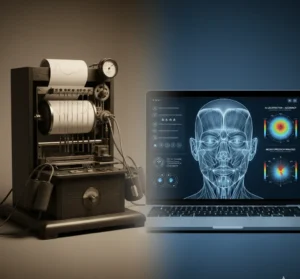
The question of how a polygraph works is one of the most common. People ask it while preparing for a test, or while doubting the very idea of a lie detector. In movies the device is shown as a magic box that "catches" lies. On social media it is portrayed as an unreliable guessing game that depends on mood. The reality is quite different. A polygraph measures specific physiological processes governed by the autonomic nervous system. This is a part of the brain that a person physically cannot control consciously throughout the 40–90 minutes of testing.
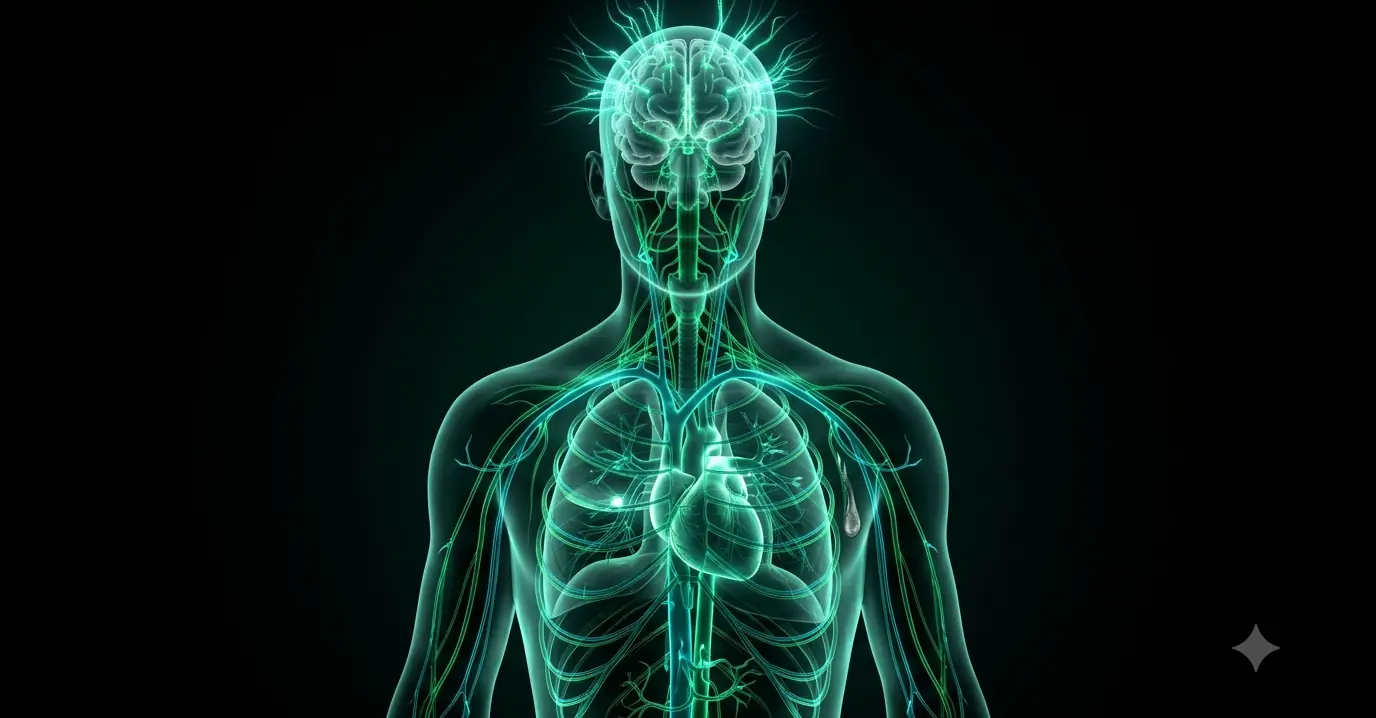
Key fact: A polygraph does not detect "a lie" as a thought — it records the physiological response of the sympathetic nervous system, which the brain triggers unconsciously in reaction to the threat of exposure. Between the moment a lie is spoken and the body's response there is a gap of 0.5–4 seconds, and this temporal pattern is one of the key indicators.
In this article we break down what happens to the body at the moment of deception. We show how the polygraph's four measurement channels combine into a complete picture. We explain why a single channel is not enough and how modern algorithms process the collected data. And we cover why the method cannot be beaten even if you know its principles. With examples and references to neurophysiology — no "the device shows a lie" metaphors.
Understanding the physiology of the polygraph matters for several reasons. First, it removes the mystique. A person stops seeing the device as a "magic box" and begins to view it as a measuring instrument with limitations, like any other. Second, it helps you prepare for testing correctly. When you know exactly what the device measures and how, you can set yourself up to go through the procedure calmly. Third, it gives you a basis for an informed choice between different diagnostic methods (a classic polygraph, online systems, FACS analysis). Each of them uses different aspects of the same fundamental bodily response to deception.
What the autonomic nervous system is and why it does not lie
The human nervous system is divided into two parts. The somatic system controls conscious movements — walking, speech, gestures. The autonomic system controls internal processes — heartbeat, breathing, sweating, digestion. The autonomic part works without the involvement of consciousness. You do not decide "now I will produce saliva," "now I will speed my pulse up by 12 beats," "now I will constrict the vessels in my palms." All of this is done by the autonomic nervous system automatically.
Within the autonomic system there are two modes. The sympathetic mode handles mobilization — the "fight or flight" response. The parasympathetic mode handles recovery — "rest and restore." When a threat is perceived, the sympathetic mode switches on in a fraction of a second. The hypothalamus sends a signal to the adrenal glands, which release adrenaline and noradrenaline into the blood. Within seconds these change dozens of the body's parameters simultaneously.
Deliberate deception is classified by the brain as a threat. This is especially true when the consequences of being caught are potentially dangerous. It does not matter whether "the person looks calm on the outside." A defensive-response scenario is launched in the deep layers of the nervous system. It is precisely this scenario that the polygraph measures.
The evolutionary roots of the stress response to deception
The sympathetic nervous system is one of the oldest systems in the human brain. It evolved over tens of millions of years as a mechanism for reacting instantly to a threat. Examples include a predator's attack, a conflict with a rival in the tribe, or a dangerous fall. Its job is to prepare the body for physical action within fractions of a second. It speeds up the heart for better blood supply to the muscles and widens the bronchi for more oxygen. It mobilizes glucose from the liver for energy. And it constricts the peripheral vessels so that blood moves from the extremities toward the core.
For our ancestors, being exposed as a liar within a social group had serious consequences. Nomadic tribes 50,000 years ago lived in groups of 30–150 people, where reputation determined survival. An exposed liar lost access to resources, mates, and the group's protection. This effectively reduced their chances of survival. That is why the brain developed a highly sensitive mechanism for reacting to situations of potential exposure. Sympathetic activation is triggered long before the conscious brain has time to assess the real danger.
Modern humans live in very different conditions: a lie about a stolen 200 hryvnias rarely threatens one's life. But the sympathetic system has not evolved over the past few millennia. It continues to react to potential exposure the same way it reacts to a predator's attack. The response is an instant bodily cascade. This is the fundamental reason a polygraph works. We still carry within us an ancient alarm system that cannot tell serious danger from social danger.
Interestingly, cultural differences in the physiological reactions of people examined on a polygraph are minimal. A Japanese person, a Nigerian, and a Canadian show similar patterns of sympathetic activation during deception. This confirms the universality of the basic architecture. Differences show up rather in behavioral markers (facial expressions, gestures, speech), which are culturally shaped. The autonomic response, by contrast, remains universal.
There are categories of people with innate or acquired peculiarities of sympathetic reactivity. Sociopaths with low reactivity show weaker activation. This partly explains why such individuals more often demonstrate "successful" deception, both in social interactions and on the polygraph. However, true sociopathic personalities make up less than 1% of the population. And even in them the reaction is not entirely absent, merely weaker. An experienced polygraph examiner calibrates the method to account for each subject's baseline reactivity.
Four measurement channels — and why one is not enough
A classic modern polygraph (Lafayette LX5000, Axciton Vector, Limestone Polygraph Pro) has four independent channels. Each of them registers different aspects of the sympathetic response. A reaction on a single channel by itself means nothing yet. The person could have coughed, adjusted their clothes, or gotten distracted. But sometimes all four channels show consistent changes in the window of 0.5–4 seconds after answering a critical question. This can no longer be explained by chance.
Channel 1: skin conductance (Galvanic Skin Response, GSR)
The fastest and most sensitive channel of the polygraph. Electrodes are attached to the pads of two fingers (usually the index and ring fingers). A micro-current is passed through the electrodes, and the device measures the skin's resistance.
During sympathetic activation the eccrine sweat glands of the palms begin to secrete water containing salts and electrolytes. This lowers the skin's resistance and increases its conductance. The skin reacts within 1–3 seconds after a stimulus and returns to baseline within 5–15 seconds. This is the fastest physiological channel. That is why it is the GSR graph that is most often shown in movies as "going off the charts."
What matters here: palm sweating is fully autonomic. You cannot train yourself "not to sweat" at a particular thought. Antiperspirants on the palms are an approach recommended online. They either do not work — ordinary deodorants do not block sympathetic activation — or they work so noticeably that the examiner immediately flags the test as a "countermeasure attempt." The giveaway is a complete absence of GSR change during emotional stimuli.
Channel 2: breathing (two pneumograph sensors)
Two elastic bands with strain gauges: one on the chest (thoracic breathing) and one on the abdomen (diaphragmatic breathing). The device records the breathing rate and the depth of inhalation and exhalation. It also records pauses and the ratio of the two types of breathing.
Sympathetic activation changes breathing within a few seconds after a stimulus. The rate rises, holds appear, and the rhythm is disrupted. Sometimes the opposite is observed — an attempt to consciously "hold the breath so as not to react." The algorithm registers this as an unnatural plateau.
Breathing is the only channel that can be consciously controlled for a few seconds (holding, slow inhale-exhale). That is precisely why online "guides to beating the polygraph" contain so much advice like "breathe 4-7-8." The problem: no one can sustain 40–90 minutes of testing in a controlled-breathing mode. And the very fact of control creates a noticeable, unnatural pattern.
Channel 3: cardiovascular activity (cardio cuff)
A cuff on the upper arm, like the one for measuring blood pressure, but with continuous monitoring. The device registers the pulse wave, arterial pressure, and the amplitude of the heartbeats.
Sympathetic activation causes constriction of the peripheral vessels, so blood moves from the extremities toward the major muscles. It also raises arterial pressure and accelerates the pulse. The reaction begins 2–5 seconds after a stimulus and lasts 10–30 seconds.
Heart rate is partly controllable through meditative techniques and breathing practices. But arterial pressure and the amplitude of the pulse wave cannot be controlled consciously. Beta-blockers are a pharmacological attempt to suppress the cardiac reaction. They create two problems. First, they do not block GSR and breathing. Second, they produce a characteristic "flat" pattern across the entire test, which is itself a marker of countermeasures.
Channel 4: muscular activity (pressure sensors in the seat)
The newest channel, which appeared in commercial polygraphs roughly from 2010. Pressure sensors built into the seat and armrests of the chair record the slightest movements. These include tension in the muscles of the buttocks, legs, and arms. They also catch attempts to press on hard objects (the legendary "button in the shoe").
This channel does not measure emotions. It detects countermeasure attempts: physical pain, muscle tension, micro-movements designed to create "noise" in the other channels. If a person presses a button in their shoe during critical questions, the seat sensors register it immediately. The test is then flagged as a "countermeasure attempt." Under strict interpretation, this is equated with a confession.
What happens in the brain at the moment of deception
Neuroimaging studies (fMRI on hundreds of volunteers) have shown a stable picture. During deliberate deception, specific areas of the prefrontal cortex are activated. This is not a "lie area," but zones responsible for cognitive control, working memory, and the inhibition of reactions.
The dorsolateral prefrontal cortex is activated when several versions of reality must be held in mind at once — the real one and the fabricated one. It helps compare them and choose what to say. The anterior cingulate cortex is activated during conflict monitoring (truth vs. lie). The inferior frontal gyrus is activated during the conscious suppression of an automatic reaction. An example is the urge to simply tell the truth.
This brain activity is measured by fMRI, but not by the polygraph. The polygraph records the consequence of this activity — the cascading sympathetic surge in response to the threat of exposure. In other words, the polygraph does not measure "the thought of a lie." It measures the bodily reaction to the risk of being caught.
Interestingly, neuroimaging studies have identified separate activation areas for different types of deception. Simple situational deception ("did I eat the chocolate?") activates a minimal set of zones. Systematic, prepared deception (a fabricated biography for an interview) engages the hippocampus and working-memory areas. Emotionally charged deception (concealing an affair) additionally activates the amygdala and limbic structures. This neurophysiological diversity explains why a polygraph can show different reaction patterns depending on the type of concealed information. It also explains why an experienced examiner takes into account not only the amplitude of the reactions but also their profile.
Daniel Langleben's research at the University of Pennsylvania from 2002–2008 showed something important. Activation during deception is detectable even when a person successfully controls their outward behavior — does not tremble, does not blush, speaks in an even voice. This confirms that behavioral signs can be suppressed. But the neurophysiological reaction arises automatically and independently of the will. It is precisely on this fundamental fact that the entire methodology of modern instrumental deception detection is based.
Cognitive load as a key factor
The modern theory of deception detection (Aldert Vrij, University of Portsmouth) shifts the emphasis. It moves from "the emotion of lying" to "cognitive load." A lie is a complex cognitive task. You have to remember the truthful version, generate a fictitious one, and control your behavior. You must also monitor the reaction of your counterpart and anticipate the next questions. All of this places a load on working memory and executive functions.
This load shows up not only in the classic polygraph channels. It changes reaction time — a lie requires more time to think through, on average by 200–600 ms. It also changes speech prosody (more pauses, fillers such as "um," "uh"), microexpressions, and eye movements. Modern online systems such as the online polygraph StimulTest are built on this principle. They measure cognitive load through reaction time to carefully selected stimuli, without any need for sensors.
Individual differences in physiological reactions
Not everyone reacts to deception in the same way. This is one of the most underestimated complications in an examiner's work. Baseline sympathetic reactivity varies across the population roughly like height or weight — most people are in the mid-range. But there are edges to the distribution. Some categories require a special approach or an adjustment of the method.
Hyperreactive individuals
Roughly 8–12% of adults have innately high sympathetic reactivity. They react more strongly to any stress — public speaking, an important interview, even routine social interactions. In the context of the polygraph this creates a problem. The reaction to neutral questions may be no weaker than the reaction to critical ones, which complicates interpretation. The modern method provides a lengthy acclimatization phase for such subjects. This includes a series of practice questions, breaks, the opportunity to drink water, and time to talk about unrelated things. This gives the brain a chance to "get used to" the situation, and the baseline stabilizes.
Hyporeactive individuals
At the other pole are roughly 4–7% of adults with low sympathetic reactivity. This includes people with a history of long-term medication (SSRI antidepressants, beta-blockers, long-term antipsychotics). It also includes patients with certain neurological conditions, and a minority of healthy people with an innately "calm" nervous system. In them the amplitude of all polygraph channels is reduced, which makes it harder to detect meaningful differences. The examiner works with such subjects with special attention. They strengthen the emotional context in the wording of the questions and use the Concealed Information Test method instead of the CQT. In some cases they recommend a combined approach with video analysis of microexpressions.
Individuals with anxiety disorders
Chronic anxiety creates a characteristic picture. There is an elevated baseline — a raised baseline level of GSR and heart rate. And there is uneven reactivity — a strong reaction to one neutral question, a weak one to another. The polygraph is not contraindicated for such subjects. But it requires preparation. It is advisable to stabilize the condition 2–3 weeks before testing, through psychotherapy and, in some cases, an adjustment of medication support. In the acute phase of a panic disorder a polygraph is not conducted, and it is recommended to reschedule.
Individuals on the autism spectrum
This is a separate category with a non-standard picture. In people with high-functioning autism (Asperger's, now the ASD level 1 category), sympathetic reactivity may be dissociated from the social context. "The threat of exposure" is perceived differently than in neurotypical people. Reactions to critical questions may be less pronounced, even when deception is present. Current practice is a preliminary consultation with a neuropsychologist and adaptation of the method. In some cases it involves the use of alternative tools — in particular, AI analysis of reaction time, which is less dependent on the social context.
Why a polygraph cannot be beaten consciously
The internet is full of advice on "how to beat a polygraph." Examples include controlling your breathing, medication, "think about something calm," and a button in the shoe. All these methods share one problem: they try to control channels that work automatically.
Consciously suppressing the sympathetic reaction in one channel (for example, through beta-blockers) does not block it in the others. GSR remains active. Controlling your breathing consumes cognitive resources and noticeably changes your reaction time to questions. A button in the shoe is registered by the seat sensors. Antiperspirants either do not work or work so completely that the very absence of a GSR reaction becomes a marker.
Most important of all — an experienced examiner does not simply read the graphs. They observe the subject's behavior, the pauses before answers, the micro-movements, the attempts to "think about something else." The sympathetic nervous system is only part of the picture. The behavioral part is no less important. And so far it is entirely inaccessible to conscious control over the course of a lengthy test.
Stress vs. deception: how a polygraph tells them apart
One of the most common objections to the polygraph: "What if a person is innocent but very nervous — how does the device tell their anxiety apart from deception?" This is an absolutely valid concern, and the methodology offers several levels of answer to it.
General stress produces an even reaction
The key difference lies in the temporal pattern. It separates the reaction to the general stress of testing from the reaction to a specific critical question. General anxiety produces an elevated baseline across all channels throughout the entire test. The heart is slightly sped up, the skin is slightly damper, and the breathing is uneven. This shows up evenly, without clear peaks in response to specific stimuli. The reaction to a specific deception question, on the contrary, is sharp and limited in time. Peaks of amplitude appear within 0.5–4 seconds after the answer, with a return to baseline within 5–15 seconds.
Control questions as a calibrator
The CQT method is specifically built to tell anxiety apart from deception through comparison. Control questions ("Have you ever taken anything that did not belong to you?") touch on general moral themes and cause discomfort in anyone. Relevant questions ("Did you take 200,000 UAH from the safe on May 12?") concern a specific fact of the situation under investigation. In an innocent person who is simply nervous, the reaction to the control questions will be stronger than the reaction to the relevant ones. This happens because the control questions touch on general moral discomfort. In a guilty person it is the opposite. The relevant questions produce a stronger reaction, because of the specific threat of exposing a specific fact. This is the core mechanism of differentiation.
A practice test before the main one
Before the main testing an acquaintance test is always conducted. It is a series of neutral questions about known facts ("Is your name Elena?", "Do you live in Kyiv?"). This test has two functions. First, it allows the subject to get used to the procedure and stabilize their baseline. Second, it calibrates reactivity. The examiner sees how this particular subject reacts to the stress of the testing itself. Without this step, the interpretation of the main results would be considerably less reliable.
What the error statistics show
False positive results (an innocent person is flagged as guilty) occur in roughly 5–13% of cases. This is with properly conducted testing. These are not "device errors" but the statistical nature of a method based on probabilities. If a result is doubtful, practice recommends re-testing with a different examiner and a modified method. In clinical cases a parallel analysis of behavioral markers (microexpressions, speech patterns) is also recommended. This provides confirmation from an independent channel.
The Comparison Question Test (CQT) — how it works
The classic testing method is the Comparison Question Test. The method does not simply ask "did you steal the money?" and watch the reaction. The stress of the accusation produces a reaction even in the innocent. Instead, the method compares reactions to two types of questions:
- Relevant questions — concern the situation under investigation directly ("Did you take the money from the safe on May 15?").
- Control questions — concern potentially uncomfortable general topics ("Have you ever taken anything that did not belong to you?").
The logic: an innocent person reacts more sharply to the control question. They fear their answer will be taken badly. A guilty person reacts more sharply to the relevant one. It is precisely that question that touches on the real threat of exposure. Comparing the amplitudes of the reactions across the four channels yields a conclusion about truthfulness.
This is not "the device showed a lie." It is a statistical analysis of the reaction pattern, validated in dozens of scientific studies. Modern computer algorithms (the Polygraph Scoring Algorithm from Lafayette, Identifi from Axciton) process the graphs automatically. They produce a numerical score with a confidence interval.
Why one channel is not enough — and why four already are
Each individual channel has a noise level. GSR reacts to any stress, and breathing can be controlled temporarily. The heart responds to physical exertion, and muscular activity can simply come from an uncomfortable posture. If a test were based on just one channel, the errors would be systematic.
Four independent channels create cross-verification. Consider the probability that all four channels would show a coordinated change in the 0.5–4 second window after a stimulus without a real emotional reaction. It is statistically close to zero. This is exactly why validated CQT methods deliver an accuracy of 87–95%. Single-channel measurement, by contrast, would produce only 60–70%.
Important: Voice stress analyzers (VSA) measure only one dubious parameter — the "microtremor of the voice." This is precisely the main reason for their low accuracy (50–65%). No serious deception-detection method is based on a single channel.
How the result is scored: the mathematics of statistical analysis
The conclusion of "truth" or "lie" on a polygraph is not the expert's subjective opinion. It is the result of statistical analysis. Modern systems use methods analogous to those applied in medical diagnostics and psychometric research.
The numerical scale and the confidence interval
Each test question receives a numerical score. It runs from -3 to +3 (the Utah Scoring System) or -1, 0, +1 (the Federal Zone Comparison Technique). Negative values correspond to a "deception" type of reaction, and positive ones to "truth." Zero means the absence of a meaningful difference. The sum of the points across all questions gives an overall score. Modern systems calculate a confidence interval — the range within which the result falls with a 95% probability. If the interval does not cross the zero line, the conclusion is unambiguous. If it does cross it, the result is flagged as "inconclusive," and re-testing is recommended.
Sensitivity and specificity
As in medical tests, a polygraph is characterized by two indicators. Sensitivity is the ability to correctly detect genuine deception. Specificity is the ability to correctly identify truth. In modern CQT methods the average sensitivity is 91% and the specificity 87%. This means that out of 100 genuine deceivers the device will correctly detect 91. Out of 100 truthful people it will correctly identify 87, while 13 will be flagged as suspicious erroneously. These figures are better than most psychometric instruments. But they are not perfect.
Blind studies and validation of the method
The best data on polygraph accuracy comes from "blind" studies. Experts analyze the graphs without knowing the real truth about the subject. The results of such analysis are then compared with documented facts. In the large Honts and Raskin study of 2003 on 311 cases, blind accuracy was 89%. This is almost identical to the results of non-blind analysis, which speaks to the objectivity of the method.
How modern algorithms work
Until the 2000s, the interpretation of a polygram was performed exclusively by an expert examiner. They used visual analysis and a scoring system. Today the leading commercial systems (PolyScore, Identifi, OSS-3) apply computer algorithms. These process each channel by several parameters at once: peak height, the shape of the reaction's rise, the duration of the return to baseline, variability, and the correlation between channels. The algorithm is trained on thousands of cases with known outcomes and produces an objective numerical score. This reduces the subjective influence of the expert.
What a "device error" means
When people speak of polygraph errors, it is important to distinguish several sources. An interpretation error (the examiner read the graphs incorrectly) accounts for roughly 3–5% of cases. A method error (the questions were worded sub-optimally) — 2–4%. And genuine physiological ambiguity (the subject produced an atypical picture) — 3–5%. Together this yields the 5–13% of errors encountered in real practice. None of these sources is connected with any magical ability to "beat the device." They are the ordinary statistical noise found in any diagnostic method.
The limits of the method — what a polygraph cannot do
A polygraph does not read minds. It does not say "what a person is hiding." It only states, with a certain probability, that "the reaction to this question is higher than expected." The specific content of what a person is concealing is determined later. This happens in the post-test interview or through targeted follow-up questions.
The method produces less clear results for certain categories of subjects:
- Sociopaths with low reactivity of the nervous system (a complete absence of an emotional response to the threat of exposure).
- People with certain mental disorders in an acute phase.
- Individuals who sincerely believe in their own false version of events (false-memory syndrome).
- Certain neurological conditions that affect autonomic regulation.
These are limits of the method, but not its failure. In most real cases the subjects are ordinary people with a normal sympathetic system. The polygraph works as claimed. For categories with limited reactivity, other methods are used. These include FACS analysis of video interviews, targeted behavioral analysis, and in some cases combined methods with AI analysis.
Age and physiology: the specifics of testing children, teenagers, and the elderly
A polygraph works differently for different age categories. This is due to physiological and neurophysiological differences that must be taken into account when interpreting results.
Children and teenagers under 16
In children the autonomic nervous system works the same way as in adults. The physiological stress response is formed by ages 8–10. But the prefrontal cortex matures later, by ages 18–22. It is responsible for the conscious control of behavior and understanding of consequences. This affects the specifics of testing. A teenager can produce clear reactions to questions, but interpretation requires caution. The reaction may be caused not by deliberate deception but by emotional conflict. Examples include fear of the parents, loyalty to friends, or a desire to please the adult conducting the test. Testing of minors is always conducted in the presence of a legal representative and with a specially adapted method. It is rarely used as the sole basis for a conclusion. Usually a polygraph for teenagers is used in difficult family cases — for example, when psychoactive substance use is suspected. It serves as one element of a comprehensive diagnosis.
Elderly people (65+)
With age, sympathetic reactivity declines somewhat due to changes in autonomic regulation. The baseline GSR amplitude falls by 15–25% compared with middle-aged people. The pulse reaction also becomes less pronounced. This is not critical for diagnosis. But it requires adaptation — the examiner calibrates the expected amplitudes with the age norm in mind. A separate difficulty is medication. Elderly people more often take drugs for blood pressure, the heart, and sleep problems. Many of these affect polygraph readings. Before testing, a consultation with a physician is mandatory. It assesses the advisability of temporarily discontinuing certain drugs (only with the physician's consent) or of adjusting the method.
The "golden middle" category — ages 25–55
This is the most optimal category for a classic polygraph. The sympathetic system works at full capacity, and the prefrontal cortex is fully mature. Background medication interference is minimal for most. The accuracy of the CQT method is highest in this age group — 90–95% when properly conducted. Most statistical estimates of polygraph effectiveness are based precisely on studies in this category.
The biochemistry of the stress response: hormones, neurotransmitters, and the mechanism of the reaction
When the sympathetic nervous system is activated, a complex biochemical reaction is launched in the body. Understanding this mechanism helps explain why the polygraph measures exactly the parameters it does.
The signal begins in the hypothalamus — a small area deep in the brain. It activates two parallel pathways. The first is the fast neural one: through the spinal cord to the sympathetic ganglia and on to the organs. This pathway produces an instant reaction (0.5–2 seconds): acceleration of the pulse, widening of the bronchi, sweating. The second is the hormonal one: through the pituitary gland to the adrenal glands. These release adrenaline, noradrenaline, and cortisol into the blood. This pathway is slower (5–30 seconds) but produces a longer-lasting reaction.
Adrenaline is responsible for physical mobilization. The heart beats harder and faster, breathing quickens, and the muscles receive additional blood supply. Noradrenaline heightens the focus of attention and sharpens perception. Cortisol — the hormone of prolonged stress — maintains an elevated level of glucose in the blood. It also suppresses functions that are unimportant at that moment, such as digestion and the reproductive system.
The polygraph records the consequences of this cascade across four channels. GSR reflects the work of the sweat glands (the fast neural pathway). The cardio cuff reflects the cardiac and vascular reaction (adrenaline and noradrenaline). The pneumograph sensors reflect the change in breathing, and the seat sensors reflect muscular mobilization. All these parameters are connected by a common source — sympathetic activation. That is precisely why a coordinated reaction across all channels at once is such a strong diagnostic signal.
Interestingly, a person can only begin to become aware of their bodily reaction 3–5 seconds after it starts. The body reacts first. By the time the subject thinks "I am going to stay calm now" or "I am going to react strongly now," the reaction has already happened. This physiological lag of consciousness behind the autonomic reaction is important. It is one of the fundamental reasons a polygraph cannot be beaten by conscious control.
How an online polygraph works using the same science without sensors
A classic polygraph measures physiology — the consequence of the cognitive load of deception. New-generation online systems, such as StimulTest, measure the cognitive load itself directly. They do this through reaction time to stimuli, decision-making patterns, pauses between answers, and cursor movements.
The principle is the same: a lie requires cognitive effort. This consistently shows up in dozens of parameters at once. The difference is that no sensors are needed and there is no need to physically come to an office. This makes the methodology suitable for mass screening, remote checking, and situations where a classic polygraph is unavailable.
The accuracy of the online method is somewhat lower than that of a classic polygraph (78–88% vs. 87–95%). But it is sufficient for most corporate and private tasks. As with a classic polygraph, the conclusion does not "read minds." It points to a statistically significant difference in reactions.
A separate aspect worth understanding is the difference in reaction speed between the physiological and the cognitive channel. The physiological reaction (GSR, heart, breathing) begins 0.5–4 seconds after a stimulus and lasts 5–30 seconds — a slow channel. But a very stable one. Cognitive load shows up in the reaction time to a stimulus — a lie requires 200–600 ms longer to formulate an answer. It also shows up in the micro-pauses before an answer. This is a fast channel that delivers information within milliseconds. A classic polygraph records the slow channel. New-generation AI systems record the fast one. Both channels are a consequence of the same neurophysiological reaction. But they provide different "windows" into the process of deception.
What modern neuroscience shows: where deception-detection research is heading
The classic polygraph is 1920s technology. The basic architecture has not changed in almost 100 years. It uses the same four measurement channels, the same question-comparison method, and the same principle of registering the sympathetic reaction. But a powerful field of scientific research has grown up around it. It gradually changes our understanding of what actually happens during deception.
Neuroimaging: from simple to complex lies
Research over the past 20 years using fMRI has shown an important finding. The brain activates different areas depending on the type of deception. Simple situational lies ("no, I did not eat the chocolate") engage the prefrontal cortex and the anterior cingulate cortex. Prolonged, prepared lies (a fabricated biography, a complex story) additionally activate the hippocampus, which is responsible for memory. They also engage the speech centers of the left hemisphere. Emotional lies with an element of shame activate the amygdala and areas connected with the processing of guilt. This confirms that "deception" is not a single brain function but different mechanisms depending on the context.
The effect of training and neuroplasticity
An interesting 2019 study from Harvard University looked at a group of professional actors and television presenters. It showed that long-term training in "controlling the face" (required in public-facing professions) somewhat reduces the amplitude of microexpressions. But it does not affect the classic physiological channels of the polygraph. This means that social training masks some behavioral markers but does not touch the basic sympathetic reaction. The polygraph remains an effective tool even for highly trained subjects.
Interactive detection: the future in combined methods
A promising direction is interactive detection. Here the algorithm adapts the questions in real time depending on the subject's reactions. If a person gives an anomalous reaction to a specific question, the system automatically generates clarifying ones. This narrows down the nature of the anomaly — genuine deception vs. an incidental emotional association. The first prototypes of such systems demonstrate an accuracy of 91–94%. This approaches the theoretical upper limit of diagnostic capability. Interactive systems are expected to become the standard in the commercial segment by 2028–2030.
The specifics of online cognitive-load analysis
Technologies of the StimulTest type develop in parallel with the classic polygraph but are based on a different physiological principle. They measure not the sympathetic reaction (which requires sensors) but cognitive load. They track it through reaction time to stimuli, decision-making patterns, and micro-pauses in mouse behavior. Recent research shows that both methods — the classic polygraph and AI analysis of cognitive load — capture different aspects of one and the same neurophysiological reaction. That is exactly why their combined use yields higher accuracy than each on its own. In a number of countries (Israel, South Korea) combined methods are already being standardized in legal examinations.
How this information will help you
If you are considering taking a polygraph — for personnel screening, a legal process, or personal matters — you now understand something. This is not a guessing game and not magic. But the measurement of real physiological processes with a scientific basis. You can leave a request for a check on the site's home page. We will advise you on the format — a classic polygraph or online cognitive-load analysis — depending on your situation.
Maybe you need a fast remote check with scientific validation and without having to travel to an office. StimulTest uses the same fundamental science of cognitive load during deception. But in an online format through an ordinary browser.
To sum up: a polygraph is not a magic device and not a guessing game. But a complex diagnostic system based on the stable laws of neurophysiology. The sympathetic nervous system reacts to the threat of exposure. It works by the same principles it did millions of years ago. The prefrontal cortex, responsible for cognitive control during deception, is activated in a predictable way. The four measurement channels of a classic polygraph provide an objective picture of what is happening in the body. Modern machine-learning algorithms make it possible to decode this picture with an accuracy of 87–95%. This accuracy is not theoretical but confirmed by dozens of validation studies on thousands of real cases.
If you have doubts about whether testing is advisable in your particular case, take advantage of a free consultation. We will analyze your individual physiological profile — the presence of chronic illnesses, your medication background, your psychological state. We will assess the advisability of the method. And we will help you choose the optimal format — a classic polygraph for critical cases or an online format for rapid screening.
A classic polygraph or online StimulTest verification — we'll pick the format for your task. Certified examiner, full confidentiality, online and in person. Leave a request — we reply within 15 minutes.
Latest articles