How many times were you lied to today? If you answer "not once," you are probably wrong. According to a landmark study by psychologist Bella DePaulo of the University of Virginia, the average adult lies one to two times a day — and those are only the deceptions the person is consciously aware of. Add in automatic social lies ("I'm doing great," "Yes, I'm busy") and the real figure reaches 6-10 episodes a day. The paradox is that we, as a society, condemn lying and practice it habitually at the same time. That is exactly why understanding the different types of liars is far more useful than simply calling everyone dishonest.
DePaulo's other finding is even more interesting: people do not lie at random. There is a clear typology of liars — by motivation, behavioral patterns, and neurophysiological reactions. Someone who lies out of politeness ("Thank you, I really love your gift") is fundamentally different from someone who manipulates a partner, from a sociopath who deceives coldly for personal gain, and from a person who sincerely believes their own inventions. Understanding this difference means holding the key to recognizing deception in real life.
So why do people lie? Psychologists identify six core motives: to avoid punishment, to gain a reward, to protect another person, to make a positive impression, to control information, and simply out of habit. The first two — the selfish motives — account for roughly 50% of all lies. The other 50% is social and altruistic lying that greases the wheels of human relationships. The problem begins when lying becomes a tool for systematically influencing someone else's life — in close relationships, in business, in the public sphere.
In this article we look at the neurobiology of lying, meet the 5 main types of liars, learn to recognize the tell-tale signals of deception, and figure out why intuition fails half the time — and what to do about it.
How the brain works during a lie: the neuroscience of deception
Lying is a cognitively more demanding process than telling the truth. When you tell the truth, the brain simply retrieves information from memory. When you lie, it has to perform several operations at once: suppress the truthful answer, construct a false one, make sure it is consistent, control facial expression and voice, and monitor the other person's reaction. All of this creates a significant cognitive load that leaves traces — behavioral, physiological, and neural.
The prefrontal cortex: the command center of deception
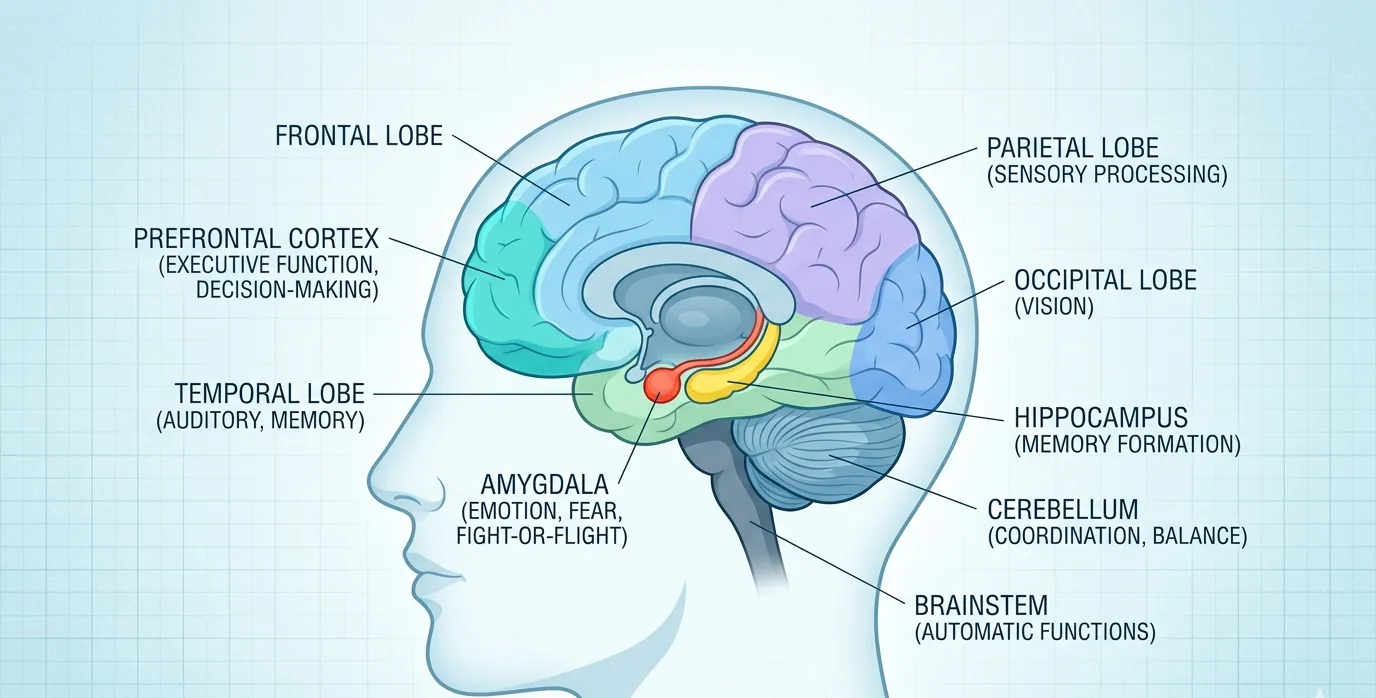
The prefrontal cortex plays the key role in lying — it is the evolutionarily youngest part of the brain, responsible for planning, decision-making, and self-control. A functional magnetic resonance imaging (fMRI) study conducted at the University of Pennsylvania in 2019 showed that during deception the dorsolateral prefrontal cortex is activated 40-60% more strongly than during truthful answers. It is this region that "inhibits" the automatic truthful response and constructs the alternative version.
The anterior cingulate cortex (ACC): the conflict detector
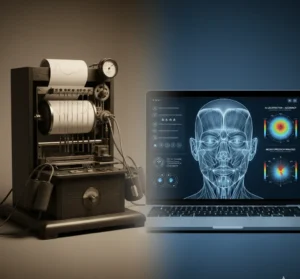
The anterior cingulate cortex (ACC) responds to cognitive conflict. When a person knows the truth and speaks a falsehood at the same time, the ACC registers this mismatch and generates a stress signal. That signal triggers a cascade of physiological reactions: an accelerated heartbeat, a change in the galvanic skin response, micro-tremors in the muscles. These are precisely the reactions that classic polygraphs are built on — yet they measure only indirectly what is actually happening in the brain.
Cognitive load as a trace of deception
Psychologist Aldert Vrij of the University of Portsmouth developed the "cognitive load approach" — a method of detecting lies through cognitive load. The core idea: because lying is harder than telling the truth, artificially increasing the cognitive load (for example, asking someone to tell a story in reverse, from end to beginning) makes the "leakage" of a lie far more noticeable. Liars lose details, get tangled in the chronology, and pause more often — while truthful people handle the task easily, because they are simply recalling real events.
Why lying can never be fully "learned"
Even the most experienced manipulator cannot completely eliminate the neurophysiological traces of deception. The prefrontal cortex activates automatically — it is not a process you can switch off by an act of will. You can learn to control facial expression, voice, and body movements — but you cannot consciously stop the rise in ACC activity or the change in skin conductance. It is exactly this feature that underlies modern technologies for the objective detection of truth.
5 types of liars: the complete psychological typology

Let's look in detail at the five main types of liars — by motivation, behavioral pattern, and detection technique. Understanding these types will help you orient yourself faster in real situations and avoid confusing, for example, a harmless social lie with dangerous manipulation.
Type 1: The pathological (compulsive) liar
Profile: A person who lies constantly, even when there is no obvious need or benefit in it. For them, lying is not a tool but a way of interacting with the world, as habitual as telling the truth is for others. Psychologists distinguish compulsive lying (pseudologia fantastica) from ordinary deception: the compulsive liar does not simply manipulate — they are captivated by creating an alternative reality.
Motivation: At the root lies a deep fear of rejection and low self-esteem. The real "self" seems to the compulsive liar not interesting, successful, or worthy of love enough. So they construct an improved version of themselves — and over time the line between reality and invention blurs. This pattern often forms in childhood, in conditions where the truth was punished and invention brought attention.
Signals: The compulsive liar's stories are incredible but impressive — they have been everywhere, know everyone, lived through extraordinary events. The details change from one retelling to the next. They can rarely give a clear answer to specific clarifying questions ("What year was that? Who else was there?"). Under pressure they retreat into a defensive posture or change the subject.
How to expose them in a minute: Ask 3-4 concrete factual questions in a row that require precise details: dates, names, the sequence of events. An ordinary person answers such questions easily, because they are simply recalling. The compulsive liar starts to "drift": "I don't remember exactly," "Something like that," "There were a lot of people there." Verify one detail — any specific, checkable one. In 80% of cases the story falls apart.
Type 2: The sociopath-manipulator
Profile: A cold-blooded liar who deceives for a specific benefit — financial, social, or emotional. Unlike the pathological liar, the sociopath is not captivated by the process — for them a lie is a pure instrument. They control their behavior, carefully construct stories, and leave no obvious traces.
Motivation: Personal enrichment, power, control. The sociopath-manipulator feels no empathy, or feels it far more weakly than the average person — so the harm their lies cause does not produce any moral discomfort in them. Robert Hare's research shows that roughly 1% of the population meets the clinical criteria for sociopathy. But up to 4% of people have pronounced sociopathic traits without a formal diagnosis.
Signals: The sociopath lies convincingly, with direct eye contact, a calm tone, and no obvious physical signs of nervousness. However, there are other markers: a lack of emotional congruence (the words are sad, the face is neutral), excessive smoothness in the stories (like a script prepared in advance), and a paradoxical unwillingness to provide independent verification ("Just take my word for it").
How to expose them in a minute: Work with facts, not emotions. The sociopath brilliantly imitates emotion. But it is hard for them to quickly invent concrete, verifiable details. Ask: "Who else was present at this meeting? Can I contact them to confirm?" Watch the reaction to the offer of verification. If a person is telling the truth, they usually welcome the chance to confirm it. If they are lying, they look for reasons why verification is impossible.
Type 3: The "white" liar (social)
Profile: An ordinary person who lies with good intentions — so as not to offend, not to cause harm, to preserve social harmony. This is the most common type of lie: by DePaulo's estimates, up to 70% of everyday deceptions fall into this category. The "white" liar is usually an honest person who simply greases the wheels of social interaction with polite inaccuracies.
Motivation: To preserve the relationship, not to hurt the other person, to meet social norms of politeness. When a friend asks how you like her new haircut and it is dreadful, you will probably say "it's fine," not "it's dreadful." This is not malicious deception but a social lubricant. The problem begins when the "white" lie spreads to serious matters — health, finances, fidelity.
Signals: The "white" liar usually shows the classic signs of nervousness — they are not used to lying and feel discomfort. The eyes may dart away quickly, the voice rises, an extra gesture appears ("fixing their hair," "touching their face"). Such a liar often changes the subject quickly after the deceptive phrase or adds justifications no one asked for.
How to expose them in a minute: Create an atmosphere of safety. The "white" liar lies out of fear of causing offense — if you make it clear you are ready for the truth and won't be offended, in 90% of cases they open up. Phrases like "Tell me straight, I can take it" or "Your honest opinion matters to me" work better than interrogations and accusations. The paradox: if you want the truth from a social liar, take away their motive to lie.
Type 4: The manipulative liar (gaslighter, narcissist)
Profile: Lies systematically and deliberately in order to control a partner's psyche, foster dependence, and assert their own superiority. Unlike the sociopath, who lies for external benefit, the narcissistic manipulator lies for an internal one — confirmation of their own grandiosity and power over another person. Gaslighting is the most common form of such lying.
Motivation: Feeding a narcissistic self-image, controlling the partner, avoiding responsibility. The narcissist cannot admit being wrong, because that destroys their idealized self-image. So they systematically rewrite history — denying what was said, distorting facts, and blaming the victim for "misperceiving" things.
Signals: The systematic nature of the lying (not one or two situations but a pattern), an aggressive reaction to any attempt to discuss inconsistencies, reverse accusations ("You're making this up," "You're paranoid"), and the absence of calm discussion — any question is perceived as an attack. The victim of such a liar often describes a feeling of "going crazy" — and that is not by chance but the goal of the manipulation.
How to expose them in a minute: A manipulative liar cannot be "caught" in a single conversation — they brilliantly turn the accusation back on you. The strategy is different: record facts in writing (messages, screenshots, dates) and build up the pattern. In the moment, ask a specific question tied to a specific fact: "You said the meeting would be at 6:00 p.m. It's right here in Tuesday's message. Why are you now saying that never happened?" Watch whether the person is able to admit the mistake or shifts into attack.
Type 5: The self-deceiver
Profile: A person who lies — but sincerely believes their own lie. This is a fundamentally different type: the self-deceiver does not manipulate consciously, they live in a distorted version of reality that the psyche created for protection. Classic examples: the partner who is being cheated on but convinces themselves that "everything is fine". The alcoholic who believes they are in control of the situation. The entrepreneur in a financial crisis who sincerely thinks they are "about to come out of it."
Motivation: Protection from an unbearable truth. Self-deception is not malicious intent but a psychological defense mechanism, described as far back as Sigmund Freud. When reality is too painful, the psyche replaces it with a more acceptable version. Research by psychologist Shelley Taylor shows that moderate self-deception is even linked to better mental health — but systematic self-deception in important areas is destructive.
Signals: Unlike the other types of liars, the self-deceiver shows none of the classic signs of deception — nervousness, avoidance of the topic, micro-expressions. They speak with conviction, because they believe it themselves. The marker is the mismatch between their words and objective facts, noticeable to an outsider but invisible to the person themselves. The paradox: the more pressure there is, the harder the self-deceiver defends their version.
How to expose them in a minute: The self-deceiver cannot be "exposed" in the traditional sense — they are not a conscious liar. The strategy is to bring them back to concrete facts through neutral questions. Not "You do understand that...," but "Look at these numbers. What do you see?" Often even this does not work — because the psychological defense is stronger than logic. The self-deceiver usually opens up only when reality becomes impossible to ignore — and that is always a painful process.
Top 7 nonverbal signals of lying (and why they don't always work)
Popular culture is full of myths about "obvious signs of lying" — from avoiding eye contact to tapping fingers. The reality is more complex: nonverbal signals are clues, not proof. Most so-called "signs of lying" occur just as often in people telling the truth under stress. Still, it is useful to know them — provided you understand their limits.
1. Avoiding eye contact
The classic signal — but with a catch: experienced liars know about this stereotype and deliberately intensify eye contact. In a study by psychologist Aldert Vrij, liars on average looked their conversation partner in the eye longer than people telling the truth. The signal works only in combination with other markers.
2. Fidgeting
Frequently interlocking the fingers, touching the face, adjusting clothing — an indicator of heightened stress. But stress can arise not only from lying, but also from an unfair suspicion, a nerve-wracking situation, or anxiety about the outcome. On its own it is not enough.
3. A rise in vocal pitch
Stress changes the tension in the vocal cords — the pitch of the voice during a lie often rises by 5-15 Hz. This is a less controllable characteristic than facial expression, and therefore a relatively reliable signal — but a baseline is needed for comparison.
4. Excessive detail
Paradoxically, liars often add superfluous details no one asked for. Subconsciously they want to make the story more convincing. A truthful account usually has natural "gaps" — a person doesn't remember everything, and that is normal.
5. A delay before answering
If a person pauses for 2-3 seconds before answering a simple question ("Where were you yesterday at 8 p.m.?"), that is a marker. A truthful answer comes quickly, because it is simply recalled. A lie requires time to construct.
6. Micro-expressions
Paul Ekman's research showed that genuine emotions leak onto the face for 1/25 of a second — faster than a person can consciously hide them. A flash of fear, contempt, or guilt at a particular question is a strong signal. However, recognizing micro-expressions requires training.
7. A mismatch between words and body
A person says "I'm glad to see you" — but the shoulders rise toward the ears in a defensive posture. They say "I'm doing fine" — but the arms are folded across the chest. This cognitive dissonance is one of the most reliable signals. The body often tells the truth even when the mouth conceals it.
Why intuition is wrong 50% of the time
A meta-analysis of 206 studies conducted by Charles Bond and Bella DePaulo in 2006 gave a stunning result: the average accuracy of a person recognizing a lie is 54%. This means relying on intuition in matters of deception is like flipping a coin. Why is that?
First, we overestimate our own ability to read people. Studies show that even professionals — police officers, judges, psychologists — rarely exceed the 60% mark. The exception is a specially trained group of secret-service agents who reach 73% — but that is the result of years of training, not natural intuition.
Second, intuition operates on stereotypes, not real markers. We expect a liar to "be nervous," "avoid eye contact," "fidget" — and we miss those who lie calmly. The sociopath-manipulator deceives precisely by not showing the "classic" signs.
Third, in close relationships a "truth bias" is at work — a bias in favor of the truth. We want to believe the people we love. Research by psychologist Tim Levine shows that in personal relationships the accuracy of recognizing a lie drops to 47-49% — below random guessing. The closer the person, the harder it is to see their deception.
The conclusion is discouraging: human intuition is an unreliable tool for detecting lies. It gives false confidence ("I've known him for years, I would have seen it") that makes us more vulnerable, not more protected. Critical decisions require other, objective methods.
Objective detection: how technology gets around the limits of human perception
All five types of liars — the compulsive one, the sociopath, and the narcissistic manipulator alike — share one vulnerability: their brains react to the truth differently than to a lie. No matter how well a person controls facial expression, voice, or behavior, the neurophysiological micro-reactions to familiar stimuli arise within milliseconds — before consciousness has time to engage its defense mechanisms.
The modern approach to detecting the truth is not the classic polygraph, which measures crude stress reactions and has a well-known problem with errors. StimulTest technology is based on neurophysiological diagnostics — recording the nervous system's reactions to specially selected stimuli. The key advantage: the method works even with the liars who successfully deceive human intuition — sociopaths, trained manipulators, people with a cold-blooded character.
For private situations — suspicions of infidelity, financial deception by a close person, checking honesty in personal matters — there is the StimulTest service for individuals. It is not a tool of aggression but a way to gain clarity where intuition no longer works — especially after a long relationship with a manipulative partner, when one's own perception of reality has become distorted.
For business — recruiting staff, checking loyalty, investigating internal incidents — StimulTest for business is designed. Objective detection of the truth makes it possible to make personnel and management decisions based on facts, rather than on the subjective impressions of a manager, which, as we have seen, are wrong in 50% of cases.
FAQ: Frequently asked questions about the psychology of lying
Can you learn to recognize lies without special training?
You can raise your accuracy from the typical 54% to 65-70% — by knowing factual techniques (asking concrete questions, checking details, requesting a story told in reverse). However, reaching the accuracy of objective detection (95%+) without technology is impossible. The best strategy is to combine critical thinking with technological verification in important situations.
Do men and women differ in recognizing lies?
The stereotype says women are more intuitive — but research does not confirm a significant difference. Meta-analysis shows that women are slightly better at recognizing emotions on the face. But that does not translate into an advantage in detecting lies. In close relationships both sexes demonstrate a "truth bias" — an unwillingness to see deception in a partner.
Do all children lie?
Yes, it is a normal stage of development. The first attempts at deception appear in children at 2-3 years and become stable at 4-5 years. The ability to lie is linked to the development of a "theory of mind" — understanding that another person may have knowledge different from mine. Paradoxically, the ability to lie in childhood is a marker of normal cognitive development.
Can neurophysiological diagnostics be fully deceived?
The classic polygraph can be deceived — and that is its well-known vulnerability. Modern neurophysiological diagnostics, which measure reactions to specific stimuli (rather than the general level of stress), are far more resistant to countermeasures. A reaction to a familiar stimulus — for example, to the name of a person you know — arises automatically and cannot be consciously controlled.
If a person lies, does that mean they are bad?
No. As Bella DePaulo showed, all people lie — and most deceptions are social, polite, and harmless. The question is not the fact of lying itself, but its scale and harm. Systematic manipulative lying in close relationships, business deception, and financial fraud are a fundamentally different category from a compliment about a bad haircut. Before condemning a person for deception, it is worth understanding its type and motivation.
Get an objective answer when intuition doesn't help
If you find yourself in a situation where the cost of a mistake in recognizing a lie is too high — suspicions of infidelity, a business partnership, personnel decisions — StimulTest technology provides objective detection based on neurophysiological reactions that cannot be consciously controlled.
StimulTest for individuals StimulTest for business Contact us
Back to the online polygraph homepage of TestStimul.
Facing a lie you can't verify on your own? A certified examiner gives you an objective answer on any of the types of liars. Full confidentiality, online and in person. Leave a request — we reply within 15 minutes.
Latest articles