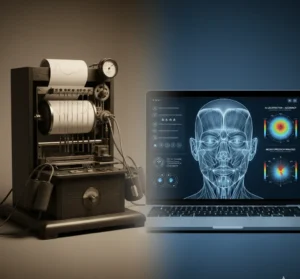
Over the past five years, lie detection technology has taken a big leap forward. Alongside the classic polygraph, we now have voice stress analyzers, fMRI-based neuroimaging, automated micro-expression recognition systems and artificial-intelligence algorithms that analyze behavior. In 2026, corporate security teams, lawyers and private clients keep asking the same question: which of these lie detection methods actually works, and which is just marketing wrapping paper?
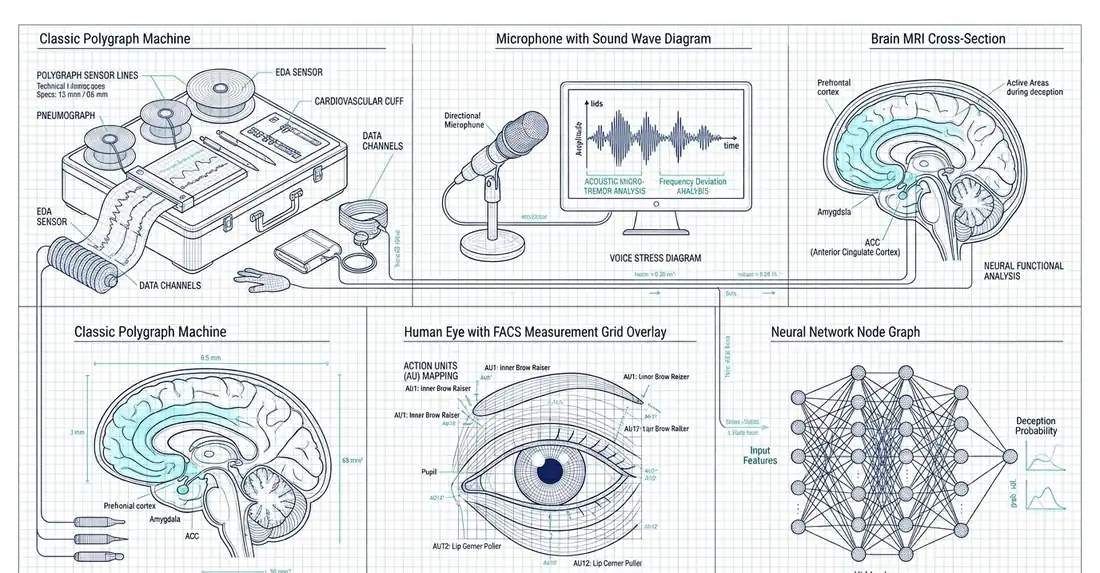
Key fact: According to a 2024 meta-analysis by the American Polygraph Association (APA), the accuracy of the classic polygraph is 87–95%, voice analyzers 50–65%, micro-expression recognition systems 54–70%, and fMRI 76–90%. The last method, however, cannot be used at scale because of its cost and complexity.
In this article we take a detailed look at the five main lie detection technologies available in 2026 — with scientific sources, accuracy percentages, legal status, cost and real-world limitations. At the end you'll find a comparison table to help you pick the right tool for a specific task. And for anyone looking for a modern solution, we'll show how the online polygraph StimulTest brings together the best ideas from all five approaches.
A brief history of lie detection methods
Instrumental attempts to detect deception have a long history. In 1895, the Italian psychiatrist Cesare Lombroso first used a mechanical device (a hydrosphygmograph) to record changes in pulse during questioning and obtained the first documented evidence that a suspect's bodily reactions differ systematically depending on whether they are telling the truth or lying. It was the first scientific work on physiological deception detection.
In 1921, the American cardiologist John Larson built the first device that simultaneously recorded pulse, blood pressure and respiration — the prototype of the modern classic polygraph. Two years later, Leonarde Keeler added a fourth channel, skin conductance (a galvanometer), and by 1935 the first commercial version had appeared, the one still recognized today as the "classic polygraph." Over the next 90 years the methodology evolved from manual chart analysis to computer scoring with machine learning, but the basic four-channel architecture has stayed the same.
Voice analyzers came much later. In 1971, the Israeli engineers Dektor and Kaglo patented the Psychological Stress Evaluator (PSE), claiming that an 8–14 Hz voice microtremor reflected stress levels and, by extension, the likelihood of deception. The technology was heavily promoted through the 1970s and 1990s until independent research showed that the claimed effect had no scientific basis. Even so, the marketing hype built a durable legend around VSA as a "next-generation polygraph" that has survived into 2026.
fMRI began to be used in deception-detection experiments in 2001, when Daniel Langleben's team at the University of Pennsylvania published the first paper on specific activation of the prefrontal cortex during deliberate deception. By 2008, two American startups (No Lie MRI and Cephos) tried to commercialize the method, but both shut down in 2023 because of legal problems and low demand — fMRI turned out to be too expensive and unstable a technology for the mass market.
Micro-expression analysis was formalized in 1978 by the psychologist Paul Ekman in the FACS system (Facial Action Coding System), which describes 43 facial muscles and all their possible movements. By 2010, FACS was used mainly by hand by experienced experts, but with the arrival of deep learning, automated systems appeared (Affectiva, Realeyes, MorphCast) that promised real-time operation yet in practice delivered far lower accuracy than human experts.
Finally, next-generation AI behavior analysis is the youngest branch, formed between 2018 and 2025. Unlike earlier methods, these systems (Silent Talker, Discern Science, StimulTest) do not try to guess a single "lie marker" but instead measure cognitive load across dozens of simultaneous parameters. This is the most active area of development right now — accuracy has climbed from 65% in 2018 to more than 85% in 2024–2025.
Why comparing the methods matters
Before 2015, the choice was simple: a classic polygraph in a specialized office. Other technologies existed but remained laboratory experiments. Over the next decade the market changed: police departments in the United States buy voice analyzers, Silicon Valley invests in AI micro-expression recognition, university labs publish papers on fMRI deception detection. The marketing noise created the impression that the polygraph was obsolete.
Reality is more complicated. Each technology measures something different and has its own strengths and weaknesses. A voice analyzer is convenient, but its accuracy barely beats a coin toss. fMRI shows what deception looks like in the brain, but it requires million-dollar equipment and a motionless patient. Micro-expressions work well in the hands of a professional, but automated systems make mistakes more often than humans do. AI behavior analysis is a young field with no long-term data yet. The classic polygraph remains the only technology with more than 100 years of research behind it and recognition in the courts of dozens of countries.
Method 1: the classic polygraph
How it works
The classic polygraph is a multi-channel recording system that synchronously logs four physiological parameters while a person answers a series of questions: skin conductance (GSR), respiration (two pneumograph sensors), cardiovascular activity (blood pressure and pulse through a cardio cuff) and muscle activity (pressure sensors in the seat). All of these parameters are controlled by the autonomic nervous system — a person cannot consciously regulate them for any length of time.
The classic testing method — the Comparison Question Test (CQT) — compares reactions to relevant questions (about the matter under investigation) with reactions to control questions (general moral statements). If a person is not hiding the truth, their reactions to the relevant questions are weaker than to the control questions. If they are hiding something, it's the other way around.
Accuracy
A 2011 meta-analysis published in the Polygraph Journal and based on 80 studies found the average accuracy of the CQT to be 87% (ranging from 83% to 95% depending on the methodology). In 2024 the APA published an updated review: when the ASTM E2062 standards are followed, accuracy is 89–93%. This is the highest figure among validated instrumental lie detection methods.
Legal weight
Polygraph results are accepted in the courts of 18 U.S. states (as supporting evidence with the consent of both parties), as well as in Japan, Israel, South Korea and several Latin American countries. In Ukraine, a polygraph examiner's report is not standalone evidence in criminal proceedings, but it is actively used in civil disputes, corporate investigations and appointments to positions in law-enforcement agencies. The European Union limits the use of the polygraph in employment relationships (personal-data protection directives). It does, however, allow it on a voluntary basis.
Cost
In Ukraine a classic test costs UAH 3,500–7,000; in Europe, EUR 250–600; in the United States, USD 350–1,200. The equipment (a Lafayette LX5000 or Axciton Vector polygraph) runs from USD 8,000 to 15,000. The procedure takes 1.5–3 hours.
Limitations
- The stress of being tested at all creates background "noise."
- Certain psychological profiles (sociopaths with low reactivity) produce a less pronounced picture.
- Cardiovascular disease, third-trimester pregnancy and acute-phase mental disorders are contraindications.
- Result quality depends heavily on the examiner's qualifications.
Method 2: the voice analyzer (Voice Stress Analysis, VSA)
How it works
VSA systems (CVSA, LVA, Layered Voice Analysis) analyze voice microtremors — fluctuations in the fundamental frequency of 8–14 Hz that are hypothesized to reflect muscular tension in the vocal cords under stress. The user records an answer into a microphone, and the algorithm flags segments of elevated "stress" as potentially deceptive.
The technology has been heavily marketed since the 1990s as "contactless," "remote" and "undetectable by the subject." In the United States, more than 1,500 police departments have bought CVSA equipment, insurance companies use VSA to vet fraud claims, and banks use it for telephone screening.
Accuracy
This is where the problems begin. Independent research consistently fails to confirm the 95% accuracy claimed by manufacturers. A 2008 study by Damphousse, conducted on 319 arrestees for the U.S. National Institute of Justice, put CVSA accuracy at 15% — worse than chance. A 2007 meta-analysis by Lykken and Senter rated all VSA systems in the 50–65% range, which is practically the same as flipping a coin.
The reason is simple: the 8–14 Hz voice microtremor either does not exist as a stable physiological phenomenon, or it does not correlate with stress and deception the way manufacturers claim. A 2006 study by the U.S. Air Force Research Laboratory concluded that "VSA does not measure anything systematically related to deception."
Legal weight
No jurisdiction accepts VSA results as evidence. In 2007, the U.S. National Academy of Sciences issued an official statement on the lack of scientific validation for voice analyzers. In 2010, the Office of Justice Programs (DOJ) recommended against purchasing CVSA for police use — yet many departments keep using it because it is cheap and simple.
Cost
One of the paradoxes is that VSA is cheaper than the polygraph. The software costs USD 1,500–5,000, and operator training takes 1–3 days. A phone check runs USD 50–150. This low cost explains why the technology spread so widely despite its poor accuracy.
Limitations
- Accuracy is at the level of chance (50–65%).
- Sensitive to microphone quality, background noise, accent and a common cold.
- No scientific validation.
- Not accepted by courts.
- Creates an illusion of "objectivity" over what is subjective interpretation.
Important: If someone offers you a "voice lie detector test in 5 minutes," that's VSA. Regardless of the brand name (CVSA, LVA, VRA), the accuracy of such a check is close to chance. Do not make important hiring or legal decisions based on VSA.
Method 3: fMRI — brain neuroimaging
How it works
Functional magnetic resonance imaging (fMRI) records local changes in blood flow in areas of the brain — the so-called BOLD signal. Research over the past decade has shown that deliberate deception activates specific areas of the prefrontal cortex (in particular the dorsolateral prefrontal cortex, the anterior cingulate cortex and the inferior frontal gyrus). Machine-learning algorithms have learned to recognize this pattern with high accuracy — from 76% to 90% under laboratory conditions.
At one point, two American companies, No Lie MRI and Cephos, offered commercial fMRI deception detection to private clients (in particular for legal cases). In 2023, both companies ceased operations because of legal restrictions and low demand.
Accuracy
In controlled laboratory experiments, up to 90%. But "laboratory" means: passive deception on simple stimuli (for example, "is this a number or a symbol?") in a sample of student volunteers. Not a single study has shown comparable accuracy on real criminal cases. Field validation of fMRI as a deception-detection method has still never been carried out.
Legal weight
U.S. courts twice (in 2010 and 2012) refused to admit fMRI evidence because of the lack of general scientific consensus (the Daubert standard). The European Union takes the same position. No jurisdiction in the world accepts fMRI as evidence of deception. Civil lawsuits from No Lie MRI clients over faulty conclusions led to the collapse of the industry.
Cost
A single scan costs USD 1,500–4,000 plus interpretation. The equipment (a 3-Tesla MRI scanner) costs USD 1.2 to 3 million. Operating expenses run USD 200,000–500,000 a year. This makes fMRI fundamentally inaccessible for mass use — it is only for academic research and exceptional expert cases.
Limitations
- Enormous cost of both equipment and a single test.
- The patient must lie completely still — any movement destroys the signal.
- Metal in the body, tattoos with metallic inks and claustrophobia are contraindications.
- No field validation.
- Not accepted by courts.
Method 4: micro-expression analysis (FACS, Paul Ekman)
How it works
Micro-expressions are brief (1/15–1/25 of a second) involuntary facial movements that, according to Paul Ekman's theory, give away genuine emotions even when a person tries to hide them. The FACS coding system (Facial Action Coding System) describes every possible movement of the 43 facial muscles and lets you "read" hidden emotions in real time.
Modern AI systems (Affectiva, MorphCast, Realeyes) automate FACS analysis: a camera records the interview video, the algorithm detects micro-expressions, and the operator receives a timeline marked with "anger," "fear," "contempt," "surprise" and so on. The technology is actively sold to law-enforcement agencies, airports and insurance companies.
Accuracy
Here's the most interesting part. Paul Ekman himself argued in his 2007 work that people trained to analyze micro-expressions detect deception with 70–80% accuracy — significantly above the average level of 54% (the very "the FBI detects lies only 54% of the time" figure that is often quoted). But all of these results are for trained experts.
Automated AI systems perform worse. A 2022 Stanford study on a sample of 1,500 interviews from real criminal cases put the accuracy of commercial AI-FACS systems at 54–62%, practically the same as chance. The reason: micro-expressions really do exist, but they are not specific to deception — a person may display "fear" or "anger" for many reasons unrelated to lying.
Legal weight
FACS analysis is accepted in the United States as an expert opinion (the Daubert standard is met), but only as supporting evidence — not as standalone proof. In Europe its use is restricted by the GDPR, since automated facial analysis is classified as processing of biometric data. In Ukraine it functions as a psychologist's expert opinion on video material.
Cost
An expert review with analysis of an interview recording costs USD 500–2,000 per hour of video. AI software (Affectiva, MorphCast) starts at USD 500 a month for a limited API. FACS expert training runs USD 3,000–6,000 plus a year of practice.
Limitations
- Micro-expressions show emotions, not deception.
- Quality depends critically on the expert's qualifications.
- AI systems are still significantly weaker than human experts.
- Sociopaths, people on the autism spectrum and people with certain neurological traits produce false results.
- Sensitive to lighting, camera angle and the subject's acting ability.
Method 5: next-generation AI behavior and voice analysis
How it works
This is a separate category that took shape between 2022 and 2025. Next-generation systems (Silent Talker, Discern Science and the newest online services such as StimulTest) combine several analysis channels: eye movements (saccades, fixations, blinking), the timing patterns of answers (reaction time to stimuli), speech prosody (pauses, intonation), micro-movements of the head and interactive psychometric elements. Machine-learning algorithms look for combinations of parameters that distinguish truthful answers from false ones, without relying on any single "deception marker."
The fundamental difference from earlier methods is that next-generation AI does not try to "guess a person's thoughts from their physiology" but instead analyzes cognitive load. The very nature of lying creates an additional load on the brain (you have to remember the truth, generate the lie, control your behavior and anticipate the listener's reaction), and this load shows up in micro-changes across dozens of parameters at once.
Accuracy
Studies of reaction-time-based systems (RT-based deception detection) show 78–88% accuracy under field conditions — significantly higher than VSA and automated FACS systems, and approaching the classic polygraph. This is a young field under active development: accuracy has grown from 65% in 2018 to more than 85% in 2024.
The advantage of next-generation AI analysis is scalability. A check can be run remotely, through an ordinary browser, without special equipment. This makes the technology suitable for mass screening: onboarding staff, verifying clients and testing in internal corporate investigations.
Legal weight
As an expert opinion, it is accepted in some jurisdictions (including Ukraine, for civil disputes). As standalone evidence in criminal proceedings, it is not yet accepted in any country. That is a question for the next 5–7 years, since the methodologies have not yet been standardized at the ASTM/ISO level.
Cost
A single online check costs USD 50–500 depending on the system and the depth of analysis. Corporate subscriptions start at USD 500 a month. The user needs no equipment (it runs through an ordinary browser with a webcam and microphone).
Limitations
- A young technology — less long-term validation data.
- Requires a stable internet connection and a working camera.
- Does not replace the classic polygraph in complex expert cases.
- Standardization of the methodology is still in progress.
Comparison table: 5 lie detection methods in 2026
| Parameter | Polygraph | VSA (voice) | fMRI | FACS | Next-gen AI |
|---|---|---|---|---|---|
| Accuracy | 87–95% | 50–65% | 76–90% (lab) | 54–80% | 78–88% |
| Cost per check | $80–600 | $50–150 | $1500–4000 | $500–2000 | $50–500 |
| Procedure time | 1.5–3 h | 15–30 min | 1–2 h | video analysis | 30–60 min |
| Remote | No | Yes | No | Yes (video) | Yes |
| Legal weight | Yes (in some countries) | No | No | As expert opinion | As expert opinion |
| Mass screening | Difficult | Yes, but useless | Impossible | Difficult | Yes, effective |
| Scientific validation | 100+ years | None | Laboratory | Partial | Developing |
Which method to choose for which task
Corporate internal investigations
If a warehouse loss or a data leak has already happened and you need to find out who was involved, the best option is the classic polygraph. High accuracy, a legally weighty report for an internal investigation, and the ability to frame specific questions for the case. An alternative for preliminary screening of a large group (10+ people) is next-generation AI: remote, fast and focused on identifying who should go on to the polygraph.
Screening candidates during hiring
For mass screening of 50+ candidates for standard positions, use next-generation AI (online format, moderate price, high speed). For a final check on key positions with access to funds or confidential information, use the classic polygraph. We do not recommend using a voice analyzer: an illusion of objectivity at the price of bad hiring decisions. Read more on the StimulTest for business page.
Checking a partner or family member
In civil and family cases, the best option is the classic polygraph. Accuracy plus confidentiality plus a legally weighty report if the result is ever needed in court. For a first approach (when you want to "probe" before speaking out loud about a full check), an online AI check works well — less stressful, cheaper and right from home.
Legal cases and court
If there is any chance the report will go to court, there is only one option — a classic polygraph with an accredited expert. fMRI, VSA and automated FACS systems are not accepted in court. In some jurisdictions, next-generation AI can serve as a psychologist's expert opinion, but not as standalone evidence.
Fast mass screening (insurance, telephone interviews)
There is no ideal option here. If you have to choose without a budget for a polygraph, go with next-generation AI in an online format. We categorically advise against VSA: its low cost does not make up for 50% accuracy.
Bottom line: Every method has its niche. The classic polygraph is the gold standard for complex expert cases. Next-generation AI (StimulTest in particular) is the best solution for online screening, preliminary checks and corporate onboarding. VSA is worth avoiding regardless of price. fMRI is a laboratory technology without field validation. FACS analysis is useful as a supporting tool in an expert's hands.
Real-world cases for each method
Theory explains capabilities well, but real understanding of a technology comes through examples of how it has been used in actual investigations, corporate cases and court proceedings. Below are anonymized examples from the practice of each method.
Classic polygraph case: an internal bank investigation
The Kyiv branch of an international bank recorded a shortfall of UAH 280,000 from one of its cash safes. Seven employees had access to the safe: 3 cashiers, 2 branch managers, the head of security and their deputy. A review of the surveillance footage gave no clear result — at the critical moment the camera showed a shadowed area. All 7 employees voluntarily agreed to take a polygraph (a condition of their employment contract for working with cash). The examination lasted 2 days, and the testing identified two suspects — a cashier and a manager acting in collusion. A further internal investigation with an audit of banking transactions confirmed their involvement. The examiner's report was used as documentary grounds for dismissal and a subsequent civil lawsuit.
A VSA case that went wrong: an insurance payout
The American insurer Allstate used a VSA check in 2014 to screen claims from car accidents. The CVSA algorithm flagged a car-theft claim from a client in Ohio as a "high probability of deception." The payout was delayed for 6 months until the client sued. In court, expert witnesses showed that CVSA has no scientific validation, and the insurer paid USD 47,000 in compensation plus USD 38,000 in emotional damages. This case became one of the precedents after which a number of states limited the use of VSA in the insurance industry.
fMRI case: disclosure of a trade secret
In 2010, an American engineer from California was accused of disclosing a trade secret to a former employer. The defense tried to use the results of a private fMRI scan at No Lie MRI, which allegedly confirmed the defendant's truthfulness. The California district court refused to admit the evidence, citing the lack of general scientific consensus on the method's validity. This case became one of the precedents after which the use of fMRI for deception detection in U.S. courts was effectively halted.
FACS case: airport screening
The SPOT program (Screening of Passengers by Observation Techniques) at U.S. airports used trained TSA officers to identify suspicious passengers by their micro-expressions and behavioral cues. The program cost USD 200 million over 4 years. A 2013 audit by the Government Accountability Office found that its effectiveness at identifying real threats was at the level of random selection. SPOT was scaled back and restructured — a classic example of how automated FACS systems fail to live up to expectations in the field.
Next-generation AI case: corporate onboarding
A Ukrainian IT company with 1,200 employees rolled out the StimulTest system for preliminary screening of new hires for critical positions (access to client data, finance, IT infrastructure). Over a year, 340 candidates were checked. Twenty-three cases of hidden risks were uncovered (unspent criminal records, false information in résumés, undisclosed work for competitors) — those candidates did not advance to the final interview. None of the 317 employees who passed the screening and were hired gave grounds for an internal investigation over the following 18 months. The savings for the company were estimated at UAH 1.8 million (preventing potential incidents).
Technologies of the future: what to expect in 2027–2030
The deception-detection field is developing rapidly. Some technologies now at the laboratory stage may go mainstream within the next 3–5 years. Let's look at the most promising directions.
EEG scanning with portable neuro-headsets
Electroencephalography (EEG) has historically been a bulky laboratory technology. Over the past 5 years, portable neuro-headsets have appeared (Emotiv, Neurable, NextMind) costing USD 500–3,000 that can read brain activity at a quality sufficient to detect P300 — a specific wave generated when significant information is recognized. The BEOS technique (Brain Electrical Oscillation Signature) is built on this principle and is already used in Indian courts. EEG methods are expected to spread into the commercial segment by 2028.
Analysis of facial thermal patterns
High-resolution infrared cameras record microscopic changes in facial skin temperature that reflect blood supply and autonomic activation. The sympathetic response during deception changes the temperature around the eyes and nose by 0.1–0.3 degrees — invisible to the naked eye but clearly captured by the camera. A 2023 study at the University of Granada showed 78% accuracy for the method. The advantage: full contactlessness and the possibility of unobtrusive verification.
Deep learning on multimodal data
The most promising direction is combining many signals at once through neural networks: facial video, voice, reaction time, eye movements and fine motor activity. The algorithm does not look for a single deception marker but learns to recognize combined patterns that distinguish truthful answers from false ones. The first commercial systems built on this principle (including the ongoing development of StimulTest) show 85–90% accuracy and promise to keep improving as training data accumulates.
Privacy and regulatory challenges
Technological progress is accompanied by growing public concern over privacy. The European AI Act, which took effect in 2024, classifies emotion- and deception-detection systems as "high risk," with strict requirements for validation, transparency and human oversight. In the United States, several states (California, Illinois, New York) passed laws in 2025 restricting the use of biometric systems without explicit consent. Forecast: the next 5 years will be a period of active shaping of the legal framework for AI deception detection, with restrictions likely tightening in Europe and greater freedom in Asia.
How StimulTest combines the best of each approach
StimulTest technology belongs to the fifth category — next-generation AI analysis. Unlike the classic polygraph, it needs no sensors and no physical presence in an office. Unlike a voice analyzer, it does not rely on dubious "voice microtremors." Unlike fMRI, it does not require million-dollar equipment. Unlike automated FACS systems, it does not try to guess deception from the face.
Instead, the system records reaction times to carefully chosen disguised stimuli and analyzes answer patterns, mouse/touchscreen behavior, pauses and corrections. Lying requires extra cognitive load — and that load shows up in dozens of simultaneous micro-changes that the algorithm detects with more than 85% accuracy in validation studies.
The check runs online in an ordinary browser, takes 30–60 minutes, and the report is generated automatically. This makes the technology suitable for situations where the classic polygraph is unavailable (geographically, financially or psychologically) but an objective, scientifically validated check is still needed.
Common myths about each method and where they go wrong
Durable myths have grown up around each of the five technologies — partly because of the movies, partly because of manufacturer marketing, and partly because of misunderstandings about the scientific details. Let's unpack the most common ones.
Myth about the classic polygraph: "it's guesswork, you can learn to beat it"
A common idea is that the polygraph "guesses" with a probability just above 50% and that any experienced "liar" can pass it. Reality: the average accuracy of the CQT method in meta-analyses is 87–95%. Accuracy rises with well-formulated questions and an experienced examiner. Attempts to "cheat" (controlling one's breathing, medication, a tack in the shoe) produce characteristic anomalies in the charts, which modern polygraph algorithms detect with 95% accuracy — that is, almost all countermeasure attempts are visible to a professional. This myth persists because cases of erroneous results get disproportionate media attention, while the 90%-plus of correct conclusions remain routine with no news value.
Myth about VSA: "a contactless polygraph, even more accurate"
VSA manufacturers' marketing heavily promotes the idea of a "revolutionary" method that "needs no sensors" and "gives the same results as a polygraph 5 times faster." Reality: independent research shows VSA accuracy at the level of chance — between 50% and 65%. The "8–14 Hz voice microtremor" effect on which the method is based either does not exist as a stable physiological phenomenon or does not correlate with deception. This myth is sustained by the fact that VSA is cheaper and simpler than the polygraph, and a large share of clients never compare results against a control group — and so live in the belief that the technology works.
Myth about fMRI: "the device of the future, sees right through the brain"
The press often presents fMRI as "a technology that shows a person's thoughts." Reality: fMRI measures local changes in brain blood flow that correlate with neuron activation — that is not a "thought" but an indirect indicator. The 90% accuracy of laboratory experiments does not repeat in the field, where no one has carried out validation studies. The technology costs million-dollar equipment plus USD 1,500–4,000 per scan. No jurisdiction accepts the results in court. This myth persists because fMRI is associated with "cutting-edge science," which creates an aura of objectivity for the general reader.
Myth about FACS micro-expressions: "the face doesn't lie"
The TV series "Lie to Me" popularized the idea that an experienced expert can almost always detect deception from micro-expressions. Reality is more complicated: Paul Ekman himself rated the accuracy of FACS-trained experts at 70–80% in his work — significantly above average, but far from "almost always." Automated AI systems perform much worse — 54–62% in the field. Micro-expressions really do exist and reflect emotions, but they are not specific to deception — a person may display "fear" or "anger" for many reasons unrelated to lying. This myth is perhaps the most durable of all, partly because of the dramatic appeal of the idea of "reading a person from their face."
Myth about next-generation AI: "artificial intelligence will solve everything"
Today's hype around AI creates the belief that machine-learning algorithms can solve any task, including perfect deception detection. Reality: AI systems show 78–88% accuracy in the field — that's better than VSA and automated FACS, but not better than the classic polygraph (87–95%). AI works well where it has plenty of data and a clearly defined signal. Lying is a complex, multidimensional phenomenon where even with millions of training examples the algorithm reaches a certain accuracy asymptote. Honest developers of modern AI systems (including the StimulTest team) acknowledge this and position the technology as a fast screening tool rather than "the final truth."
Recommendations for different types of organization
The choice of method depends not only on technical characteristics but also on the type of organization, its budget, the legal context and the volume of tasks. Let's look at recommendations for three typical categories.
Large corporations and financial institutions
For organizations with 500+ employees and turnover above a billion hryvnias, a combined strategy is best. An online AI check (StimulTest or equivalents) is used as the first level of screening for all candidates and for periodic monitoring of current staff. The classic polygraph is used for top positions (C-level, division heads, managers with access to critical systems) and in cases of specific incidents (internal investigations, loss of assets, corporate espionage). FACS analysis of video interviews is integrated as an additional layer for especially important cases. The budget for such a model starts at UAH 200,000 a year for an organization with 1,000 employees.
Small and medium business
For companies with 20–200 employees, a classic polygraph for every candidate is economically unjustified. The optimal strategy: an online AI check as the standard for all key positions (financial managers, accountants, IT admins, salespeople in retail chains). The classic polygraph is brought in only for actual incidents. The budget runs from UAH 30,000 to 100,000 a year. We do not recommend using voice analyzers in this category: the savings are pennies and the accuracy is insufficient for business decisions.
Private clients and individual cases
For private individuals (suspicion of a partner's infidelity, family disputes, personal doubts), the choice of method depends on whether the result will go to court. For a final report with legal weight — a classic polygraph in a specialized office, UAH 3,500–7,000 per procedure. For preliminary "reconnaissance" (when you want to check a suspicion before talking to your partner about serious testing) — an online StimulTest check for USD 50–150. Many private clients go through both methods in sequence: first online for preliminary certainty, then the classic method for a final report they can show to a lawyer.
What to do next
If you are choosing a method for a specific task, use three criteria: will the result go to court (then — a classic polygraph), do you need fast mass screening (then — next-generation AI), or is this a one-off important check where you can come to the office (then — a classic polygraph). VSA, fMRI and automated FACS systems add nothing in most real-world scenarios.
It's also important to consider the time factor. A classic polygraph requires an appointment in advance, a visit to the office in person, and a full procedure lasting 1.5–3 hours. An online AI check runs through a browser in 30–60 minutes at a time convenient for the subject. For urgent cases (a suspicion in an internal investigation, an emergency check on a candidate before an important decision), the online format offers a speed the classic method cannot match.
Another important aspect is the subject's psychological comfort. A classic polygraph with sensors on the body and the official setting of an office creates stress that can itself distort results for anxious people. An online check in the familiar home environment reduces this background stress and gives a cleaner signal. For groups with high baseline anxiety (people with a history of panic attacks, older people, people with previous negative testing experiences), the online format often produces a more accurate result than the classic polygraph.
If you are considering an online check with AI technology, try StimulTest. Simple registration, a check from home through a browser, a detailed report on the results, and full confidentiality. You can book a check on the site's home page, and a free preliminary consultation is available every day.
If you need a classic check with an in-person visit to a polygraph examiner's office, you can also leave a request, and we'll recommend an accredited specialist in your region. Every method has its niche — our goal is to help you choose the right tool for your specific situation.
Let's sum up the key points. In 2026, the deception-detection market offers five main technologies with radically different characteristics. The classic polygraph is the most validated method, with more than 100 years of research history and recognition in the courts. Next-generation AI is a fast-growing segment with accuracy approaching the classic method but the advantages of an online format. VSA is a technology to stay away from, regardless of price. fMRI is a laboratory curiosity without field validation. FACS analysis is a useful supporting tool in an expert's hands but weak in automated systems. The right choice depends on your specific task, budget, legal requirements and time frame — and in this article we have provided the tools for an informed decision.
We'll match the method to your case: a classic polygraph or online StimulTest verification. Certified examiner, full confidentiality, online and in person. Leave a request — we reply within 15 minutes.
Latest articles