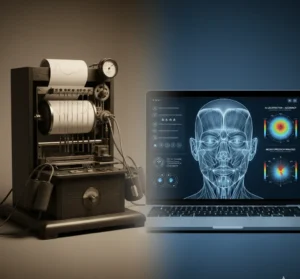
Picture this: an FBI agent with 20 years on the job, interrogating suspects every day, actually detects lies with an accuracy of just 54%. This is not a mistake or a sensational exaggeration. It is the result of a meta-analysis of 206 scientific studies published by Charles Bond and Bella DePaulo in the prestigious journal Personality and Social Psychology Review (2006). The studies involved more than 24,000 participants — from ordinary people to seasoned police officers, prosecutors, judges, customs officials and intelligence agents. And the result was equally disappointing for every category. So when it comes to how to detect lies, even the pros are barely ahead of chance.
Why is that? It seems as though a person who has worked with suspects and witnesses for decades should be able to see right through a lie. Why is our brain, so powerful at solving complex problems, so helpless in the face of a simple untruth? And, most importantly, are there ways to get around this biological limitation?
In this article we will unpack the key studies by Paul Ekman, Mark Frank and the John Reid institute, explain why cognitive biases make us blind to deception, debunk the TOP 7 myths about the "signs of lying," and show how modern technology — including reaction-time analysis — makes it possible to bypass human subjectivity. This information will be useful to HR specialists, managers, lawyers, psychologists, journalists — anyone who makes decisions every day based on the words of others.
The key figure from the research
A meta-analysis of 206 studies involving 24,483 people showed that the average accuracy of human lie detection is 54%. At the same time, the accuracy of identifying the truth is 61%, while the accuracy of catching a lie is only 47%. In other words, statistically people "miss" a lie more often than they see one where there is none. (Bond & DePaulo, Personality and Social Psychology Review, 2006.)
The study that shocked the world: 54% accuracy among professionals
The systematic study of the human ability to detect lies began back in the 1970s, when the psychologist Paul Ekman — the very man whose work was later popularized by the TV series Lie to Me — started documenting facial microexpressions. But the real breakthrough kept science waiting for thirty more years.
The Bond and DePaulo meta-analysis (2006): a harsh verdict on intuition
In 2006, Charles Bond (Texas Christian University) and Bella DePaulo (University of Virginia) published the paper "Accuracy of Deception Judgments" — the largest meta-analysis on the topic in history. They combined data from 206 separate studies conducted across 24 countries. The total sample exceeded 24,000 people of different professions, ages and cultural backgrounds.
The conclusion was unambiguous: the average accuracy was 54%. No professional group showed substantially better results. Police officers, judges, psychiatrists, customs agents, psychologists with doctoral degrees, schoolteachers, homemakers — all of them were roughly the same. What is more, the level of confidence in one's own judgment barely correlated with its correctness: people who were "absolutely certain" of their verdict were wrong just as often as those who had doubts.
Mark Frank's research: when professionals really are (slightly) better
Mark Frank (University at Buffalo), a student of Paul Ekman, ran a series of studies in which he tried to find the "exceptional professionals." He tested FBI agents, CIA officers, U.S. Secret Service agents, sheriffs and forensic experts. The result: only a narrow subclass of U.S. Secret Service agents showed a statistically significant result — around 64%. That is better than average. But it is still far from ideal. In 36% of cases, even the best professionals in the world get it wrong.
Interestingly, Frank uncovered a paradox: the more years of professional experience an officer had, the higher his confidence in his own abilities. But the accuracy barely changed. In other words, experience produced a feeling of competence, not competence itself.
The Reid Technique and its critics
The John Reid institute in the United States spent decades training investigators in the "Reid Technique" — an interrogation methodology based on observing nonverbal behavior. This method became the standard in American policing. However, a number of independent studies (notably by Kassin, Meissner and Gudjonsson) showed that graduates of Reid Technique courses, while becoming more confident in their judgments, did not become substantially more accurate. What is more, they more often wrongly convicted the innocent — because their "trained intuition" produced false alarms on the stress reactions of honest people.
In 2017, one of the most famous investigative firms in the world, Wicklander-Zulawski & Associates, publicly abandoned the Reid Technique, citing exactly this scientific evidence. It was a symbolic moment — the industry admitted that the classic "reading people" approach simply does not work reliably enough.
So what does work? Before answering that, we need to understand why the human brain handles this task so poorly.
Why the human brain can't catch a lie
The notion that "an experienced person can see a lie" is deeply rooted in our culture. But the neuroscience and cognitive psychology of the last 40 years have steadily been dismantling it. Our brain simply did not evolve to reliably detect deception under the conditions in which we live today.
Truth bias: we believe by default
The first and most important cognitive factor is truth bias. Research by Timothy Levine (University of Alabama at Birmingham) showed that in most social situations people automatically assume that the person they are talking to is telling the truth. This is not laziness or naivety — it is an evolutionarily ingrained strategy. On average a person hears around 200 untrue statements a day (including polite ones like "everything's great" and "that really suits you"), and if we all treated every word with suspicion, social interaction would simply grind to a halt.
In his "Truth-Default Theory," Levine argues that we only switch into suspicion mode when we receive a very strong alarm signal — for example, a clear factual contradiction. In its normal mode the brain works like a "trusting machine," and that is exactly why 47% of lies simply pass unnoticed.
Halo effect: the attractive are believed more
The second powerful factor is the halo effect. Back in 1920 the psychologist Edward Thorndike described it: one positive trait of a person (an attractive appearance, a well-placed voice, a confident posture) automatically "spills over" in our assessment onto other traits — for example, onto honesty.
A 2010 study conducted at Cornell University showed that photographs of people rated as "attractive" elicited a significantly higher level of trust, even when the participants had no information about those people whatsoever. A similar effect is observed with people in expensive clothing, with clear diction, with a confident smile. None of these factors has any connection to the truthfulness of what is being said — but the brain takes them into account when making a decision anyway.
Confirmation bias: we see what we are looking for
The third pillar of cognitive blindness is confirmation bias. If we already suspect a person of lying, our brain begins to selectively notice everything that supports this hypothesis: avoiding eye contact, nervous movements, pauses. And to ignore everything that contradicts it — calm, direct, confident answers.
And the reverse is true: if we consider a person honest by default (for example, it is our relative, a long-time colleague, a charismatic leader), we will miss the most obvious signs of deception. That is precisely why the victims of financial pyramids and scams often say: "I've known him for 10 years, how could I have suspected?" It is not that they "could" have — the brain was actively blocking such thoughts.
Othello error: honest people get nervous too
The fourth classic mistake, described by Paul Ekman, is the Othello error. As in Shakespeare's tragedy: Othello sees Desdemona's fear and interprets it as proof of infidelity, when in reality she is afraid that she will not be believed. We regularly interpret the stress reactions of honest people (a trembling voice, a racing pulse, avoided eye contact) as signs of lying. The result: the innocent are convicted, while calm psychopathic liars pass the "test" brilliantly.
Cognitive load: lying is hard, but not for everyone
The classic theory of Aldert Vrij (University of Portsmouth) holds that lying is cognitively harder than telling the truth. A liar has to simultaneously keep the real version of events in mind, construct a plausible alternative, monitor the reaction of the person they are talking to, and control their own nonverbal behavior. This creates a "cognitive load" that can be detected.
The trouble is that different people cope with this load differently. Sociopaths, actors, seasoned con artists, diplomats, salespeople — all of them have trained themselves to lie without visible stress. Meanwhile honest but self-conscious introverts can display the "classic signs of deception" simply by telling the truth to a stranger.
Why "experience" doesn't help
A study by Kassin and Fong (1999) revealed a paradox: students who took training in lie detection using the classic method became worse at identifying the truth (from 56% down to 46%), even though their confidence in their answers grew significantly. This phenomenon came to be called "the Dunning-Kruger effect in lie detection": training gives the illusion of competence without any real improvement.
The TOP 7 myths about how to detect lies
Most of what "everyone knows" about the signs of deception are myths that popular culture has cultivated for decades. Let us go through the most common ones, relying on scientific evidence.
Myth 1: "A liar won't look you in the eye"
The most popular and most harmful stereotype. DePaulo's meta-analysis (2003) showed that there is no statistically significant link between avoiding eye contact and lying. What is more, in many cultures (Japan, South Korea, partly the Arab countries) direct eye contact with an authority figure is considered impolite — and an honest employee from Tokyo will avoid a recruiter's gaze regardless of whether he is lying or not. Experienced liars, on the other hand, often deliberately maintain eye contact, because they know about this myth.
Myth 2: "Liars fidget nervously"
The Global Deception Research Team study (2006) showed that fidgeting (small nervous movements) is an indicator of anxiety, not of lying. Honest people can be anxious too — in a job interview, in an interrogation, in front of a camera. Some liars, on the contrary, display excessive stiffness and immobility, trying to control every gesture.
Myth 3: "Looking up and to the left gives away a lie"
This myth comes from popular NLP. It claimed that "a right-handed person who is remembering looks up and to the right, while one who is inventing looks up and to the left." In 2012, a study by Wiseman, Watt, ten Brinke and others, published in the journal PLOS ONE, refuted this hypothesis completely. A controlled experiment with 32 participants found no connection whatsoever between the direction of gaze and the truthfulness of a statement.
Myth 4: "Touching the face is a sign of lying"
A stereotype widespread in the media: "if he touches his nose, he's lying." In reality, people touch their faces on average 23 times an hour regardless of the content of the conversation. This is a self-soothing gesture (self-touch), associated with stress in general, not with lying specifically.
Myth 5: "The polygraph catches lies for sure"
A classic polygraph measures physiological responses — pulse, blood pressure, sweating, breathing rate. It does not measure "lying" directly, only stress reactions. The U.S. National Academy of Sciences report (2003) states it plainly: the accuracy of the polygraph in real conditions ranges between 60-80%, and in some cases falls below that. This is exactly why the polygraph is not accepted as evidence in the courts of most developed countries.
Myth 6: "A change in the voice gives away deception"
There is more truth here — voice parameters (pitch, volume, pauses) really can change when someone lies. But individual differences are so large that it is impossible to use the voice as the sole criterion. Some people raise their pitch when telling the truth, others when lying. Without a baseline (how this particular person speaks in a calm state), analyzing the voice is nearly hopeless.
Myth 7: "I can just feel it when someone is lying"
The most dangerous myth of all is the belief in one's own "intuition." As the research by Bond and DePaulo showed, people who trust their intuition the most have the very same accuracy of 54% as everyone else. Intuition is not a magic radar, but the sum of previous cognitive biases. And it is precisely confidence in it that leads to judicial errors, hiring failures and catastrophes of trust.
What science says
In his book "Detecting Lies and Deceit: Pitfalls and Opportunities" (2008), Aldert Vrij summed up 30 years of research: there is no single "indicator of lying" that works reliably for all people. Lying shows up not in specific gestures, but in patterns — complex changes in several parameters at once. And to the human eye these patterns are almost imperceptible.
What actually works: microexpressions and cognitive-response analysis
If ordinary observation yields only 54%, are there methods that work better? Yes — but they require technical instruments and a strict methodology, not "intuition."
Paul Ekman's FACS: a catalog of 43 facial muscles
The greatest contribution to the scientific study of facial expression was made by Paul Ekman together with his colleague Wallace Friesen. In 1978 they published the Facial Action Coding System (FACS) — a complete anatomical catalog of the movements of all 43 facial mimic muscles. Each elementary movement was given a code (Action Unit, AU). For example, AU4 is a furrowing of the brows, AU12 is the raising of the corners of the lips in a smile.
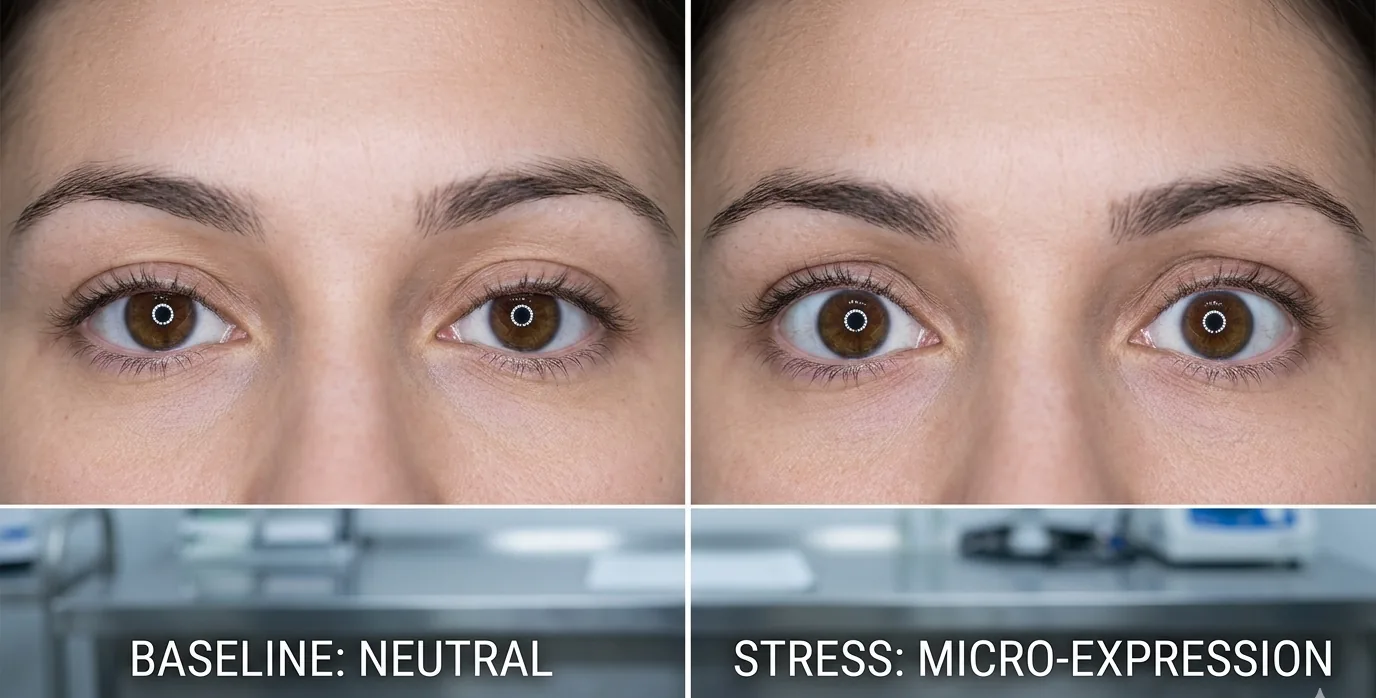
Ekman found that when someone lies, microexpressions often appear — full-fledged emotional expressions that last 40-200 milliseconds. They arise involuntarily, before a person has time to control them. For example, at the question "Did you take the money?" a fleeting asymmetrical smile of satisfaction (AU12 + AU14, "duping delight") may flash across a guilty person's face for an instant — and vanish immediately.
Why microexpressions are hard to use without technology
The problem: 40 milliseconds is at the very edge of human perception. Most people, watching in real time, simply do not notice these microexpressions. With special training (for example, the Microexpressions Training Tool that Ekman developed for the TSA), recognition accuracy can be raised to 70-75% on training videos — but in real life, without the ability to replay the recording, effectiveness drops.
That is why the modern approach is not to "train the eye," but to record the interaction on video and analyze it frame by frame, preferably with the help of computer-vision algorithms that see the AUs automatically and do not miss a single one.
Analysis of cognitive responses: the new frontier
Modern science is moving in a different direction — from observing the consequences of lying (microexpressions, voice, body) to measuring the process itself of cognitive load. This approach is based on one simple idea:
When a person tells the truth about a familiar fact, the brain retrieves this information from memory quickly and efficiently. But when a person lies, the brain is forced to perform additional operations: suppress the truthful answer, construct a false one, check it for plausibility, and reconcile it with previous statements. All of this takes more time — on average 200-500 milliseconds more.
This reaction time can be measured with millisecond precision. Unlike microexpressions, it does not depend on acting skill — even the most experienced liar cannot think faster than his neurophysiology allows. And it is precisely this principle that underlies the modern detection technologies that go beyond subjective human perception.
Technologies that outpace humans: AI, eye-tracking, reaction-time analysis
Over the past decade, lie detection has turned from an art into an exact science. Several technological directions have significantly raised accuracy — and, importantly, removed subjective "human intuition" from the equation.
Eye-tracking: where the eyes look during a lie
Research by John Kircher's group (University of Utah) showed that when someone lies, eye parameters that a person cannot consciously control change — pupil diameter (pupillometry), blink rate, gaze fixations. Eye-tracking systems capture these parameters at a frequency of 60-1000 Hz and provide objective data. Accuracy is 80-85% with the right protocol.
Voice analysis and VSA
Machine-learning algorithms have learned to detect changes in voice micro-tremor that correlate with stress. Voice Stress Analysis (VSA) technology is used by some organizations, although its validity is still being debated. A more modern approach is linguistic analysis of text (Linguistic Inquiry and Word Count, LIWC), which detects structural sentence patterns typical of made-up stories.
Computer vision and microexpression recognition
Systems based on convolutional neural networks (CNNs) now automatically recognize all 43 FACS Action Units in real time. A 2019 study (Liu et al.) showed accuracy of 90%+ under laboratory conditions. This is fundamentally higher than human performance.
Reaction Time Analysis: the gold standard
The most promising direction today is the analysis of reaction time to stimuli. The idea is simple: the subject is shown a series of stimuli (words, images, questions), and the exact delay between the stimulus and the response is measured. Relevant stimuli (those that are significant to the subject) cause the response to slow down by hundreds of milliseconds compared with irrelevant ones — and this effect cannot be hidden.
This approach has several fundamental advantages:
- Objectivity: the time is measured by an instrument, not judged by an "expert."
- Resistance to countermeasures: even if the subject knows about the method, he cannot think faster than his own neurophysiology.
- Remote administration: no sensors, wires or physical contact are needed — a computer or a smartphone is enough.
- Scalability: testing can take place anywhere there is internet.
It is exactly on this principle that StimulTest technology is built — a Ukrainian development that adapts the scientific methodology of reaction-time analysis to real business tasks: screening employees, vetting candidates, and clarifying family conflicts. Instead of relying on human intuition with its 54% accuracy, the system works with objective neurocognitive parameters.
How StimulTest solves this problem
StimulTest is an online platform that uses a scientifically grounded method of reaction-time analysis to detect the concealment of information. Unlike the classic polygraph, which measures physiological stress (and often gets it wrong on honest but anxious people), StimulTest works with neurocognitive patterns: it shows the subject stimuli related to the subject of the check and records millisecond delays in the response.
This methodology bypasses the three main limitations of human detection: truth bias (the system does not "believe" by default), halo effect (the subject's appearance does not affect the result) and confirmation bias (the algorithm has no prior hypotheses). The testing is remote, takes 15-30 minutes and requires no special equipment — a computer with internet is enough.
In particular, StimulTest for business helps HR specialists vet candidates for key positions and investigate cases of theft or information leaks, while the solution for individuals is used to clarify family and personal matters. You can learn more about our online polygraph or get in touch through the contact form.
Frequently asked questions (FAQ)
Is it true that FBI agents detect lies only 54% of the time?
Yes, this is confirmed by a meta-analysis of 206 scientific studies (Bond & DePaulo, 2006). The average accuracy is 54% regardless of profession. Only a narrow subclass of U.S. Secret Service agents showed ~64% — but even that is far from reliable.
Can you learn to detect lies better?
You can — but not by much. Microexpression training raises accuracy by 5-10 points under laboratory conditions. In real life the effect is even smaller. Only technological instruments provide a fundamentally higher accuracy.
How is StimulTest different from a polygraph?
A classic polygraph measures physiological stress (pulse, sweating) and often produces false alarms on anxious honest people. StimulTest measures neurocognitive parameters — the reaction time to stimuli, which does not depend on the general level of anxiety. The testing is conducted remotely, without sensors.
Can StimulTest be fooled?
The method is based on the neurophysiological limits of the brain's information-processing speed. It is impossible to consciously think faster. That is why the standard countermeasures (like those that work against a polygraph) are ineffective here. The system also detects attempts to artificially delay all answers.
How long does the testing take?
A standard online test on StimulTest lasts 15-30 minutes depending on the number of questions. Preparing the protocol and interpreting the results takes additional time. Everything is done remotely.
Whether it is a workplace investigation or a personal matter, get objective answers based on reaction-time analysis instead of guesswork. Certified examiner, full confidentiality, online and in person. Leave a request — we reply within 15 minutes.
Latest articles